

Ahmed Kamel – Egypt Daily News
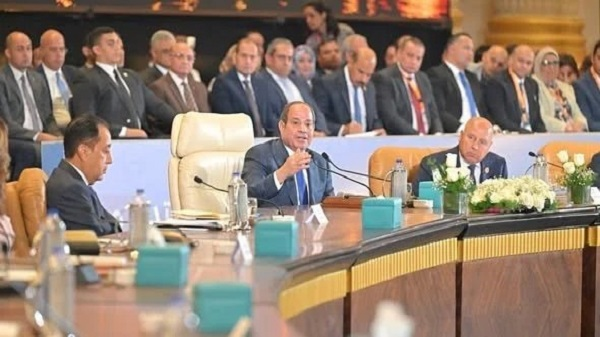
President Abdel-Fattah El-Sisi used a national security session at Egypt Forum 2026 to call for stronger public confidence in state institutions, closer communication between officials and citizens, and continued vigilance over regional threats. The discussion brought together senior officials responsible for defence, policing, foreign affairs, crisis management and water resources.
The session took place on the forum’s third day and was attended by Prime Minister Mostafa Madbouly, Defence Minister Ashraf Salem Zaher, Interior Minister Mahmoud Tawfiq, Foreign Minister Badr Abdelatty and senior military officials. The forum, running from October 19 to 24, was presented as a venue for reviewing government policies and discussing national challenges.
A film shown at the session highlighted the Interior Ministry’s work on public safety and its response to citizens’ reports. Tawfiq said the ministry had updated its approach to policing as criminal methods changed, citing a reported 94 percent decline in car theft. He outlined five areas of reform: modernizing police facilities and equipment; using technology and artificial intelligence to identify emerging crime patterns; developing specialist personnel, including in cybercrime and intellectual-property cases; improving public awareness; and updating the treatment of convicted people.
President El-Sisi urged the police and armed forces to strengthen their engagement with the public and provide information about their work. He said negative perceptions of the Interior Ministry could be reinforced through everyday interactions, sometimes unintentionally, and called on the ministry to develop initiatives to improve and maintain public confidence.
The president also returned to the political upheavals of 2011, warning that attacks on state institutions could weaken the country. He cited the storming of police facilities and prisons and the escape of 33,000 prisoners as examples of the consequences he associated with the period. President El-Sisi argued that a state’s ability to withstand crises depended on strong institutions that retained public trust.
He defended the conversion of prisons into correction and rehabilitation centres, describing the policy as an effort to treat people humanely and focus on rehabilitation rather than imposing repeated punishment for the same offence. He called for visits to the centres so the public could see the changes, and asked the defence and interior ministries to develop further ways of communicating with citizens.
Military official Mohamed Abdel Rahman Rabie presented the National Authority for Crisis and Emergency Management as a support body for the government during emergencies. He said its administrative and legal framework had been completed and that it had the executive bodies and data systems needed to coordinate responses across the country. President El-Sisi described the authority as an additional source of information and support for state agencies.
Foreign Minister Abdelatty said Egypt’s external relations were closely connected to its domestic stability, particularly because the country is surrounded by states facing conflict or political upheaval. He described Egypt’s approach as “strategic balance,” with partnerships maintained across global powers and regional actors.
On the Red Sea, Abdelatty said Egypt sought security through cooperation with countries bordering the waterway, including logistical, economic and tourism partnerships. He also emphasized the importance of African development to Egypt’s economic future, pointing to the president’s visits to African countries and describing engagement with the continent as a means of strengthening solidarity.
Water security featured prominently in the discussion. Abdelatty called it an existential issue and said Egypt opposed any unilateral action that could threaten the water supply of its population. He said Egypt’s policy toward countries in the Horn of Africa was based on non-interference, respect for sovereignty and territorial unity, and coordination on questions such as access to the sea.
Water Resources and Irrigation Minister Hany Sewilam outlined projects intended to conserve water and expand reuse, including treatment facilities, canal lining and the New Delta project. He said treated and reused water had reached 23.2 billion cubic metres annually. Sewilam also criticized Ethiopia for not implementing the 2015 Declaration of Principles on the Grand Ethiopian Renaissance Dam, and said a draft agreement reached during Washington-hosted talks had not been signed by Ethiopia.
The minister argued that cooperation across the Nile Basin could address shared needs, including electricity, water storage and flood protection. He cited Egyptian investments of $120 million in southern Nile Basin countries and described projects involving wells, small dams and weather-forecasting support. His comments reflected Cairo’s position that Nile countries could pursue development through coordination rather than unilateral decisions.
On Sudan, Abdelatty said Egypt supported the country’s unity and state institutions and opposed its partition. He said Egyptian diplomatic efforts with regional partners were continuing to seek a political settlement. Regarding the Palestinian issue, he reaffirmed Egypt’s rejection of displacement and said more than one million tonnes of aid had entered through the Rafah crossing.
President El-Sisi concluded by linking Egypt’s security to stability across the Arab region, including in the Gulf, Sudan, Libya and Somalia. He said any Egyptian military contribution to protecting Saudi territory or another Arab state would be defensive and conditional on a request, and would not involve an attack on Yemen.
President Sisi Highlights Food Reserves, Agricultural Expansion and Water Governance at Egypt Forum
President Abdel-Fattah El-Sisi used a session on food and water security at Egypt Forum 2026 to outline the government’s efforts to strengthen supplies, expand agricultural production and improve management of water and fisheries. He said Egypt’s strategic reserves of essential commodities were sufficient for six months, while stressing that regional geopolitical tensions and disruptions to supply chains remained important considerations.
The session, titled “Food and Water Security: Today’s Challenges and Future Guarantees,” took place on the forum’s third day. Prime Minister Mostafa Madbouly attended alongside the ministers responsible for supply, water resources and irrigation, and agriculture, as well as officials, lawmakers, researchers and representatives of agricultural workers.
The discussion reviewed measures undertaken since 2014 to support food security. These included reclaiming and developing agricultural land, improving commodity-supply systems, directing subsidies to eligible households and expanding silos and storage capacity. The agenda also reflected pressures identified by officials ahead of the forum: population growth, limited water resources, climate change and volatility in international markets and supply chains.
President El-Sisi said the government wanted to move toward cash-based subsidies, arguing that the approach could be fairer and more transparent if supported by effective governance. He said information on citizens had been collected to help establish the system and ensure that assistance reached its intended recipients. The shift would mark a significant change from Egypt’s established food-subsidy system, which includes support delivered through essential commodities. Its effectiveness, the president’s remarks suggested, would depend on accurate records and safeguards for households that rely on assistance.
On agricultural production, President El-Sisi emphasized the need to improve livestock productivity by replacing older animal breeds with more productive ones. He called on governors, local officials, community leaders and citizens to contribute to that effort, presenting it as a shared responsibility rather than a task for ministries alone.
He also addressed the condition of Egypt’s lakes, saying decades of encroachment, neglect and pollution had damaged fisheries and reduced production. Some lakes, he said, had received untreated sewage and agricultural drainage. The government had taken action against violations and sought to restore the lakes, including Lake Bardawil, Lake Manzala and Lake Nasser.
President El-Sisi said the state had assigned the Future of Egypt for Sustainable Development Authority a supervisory role in the lakes, arguing that additional institutional capacity had been needed to address longstanding problems. He expressed hope that fish production would return to more normal levels, citing the importance of the lakes to food supplies and to residents of Port Said, Damietta and Dakahlia.
The involvement of the authority, which also has a prominent role in large-scale agricultural development, illustrates how the government is coordinating food, land and water initiatives through major state-led projects. The broader forum agenda has placed these efforts alongside questions about self-sufficiency, import dependence and the infrastructure needed to move and store food.
On land reclamation, President El-Sisi described projects undertaken since 2014 as unprecedented in scale compared with earlier efforts, which he said had not achieved their intended results. He said the government was open to private companies buying reclaimed land, provided that sales involved large areas. That condition, he argued, would help avoid fragmenting agricultural holdings a pattern he said had not served the country’s interests.
The president said Egypt would be prepared to reclaim 10 million feddans if the necessary water resources were available. He underlined that the objective was to produce tangible results, pointing to the New Delta project as an example of the scale of infrastructure required. The project, he said, had involved major works, including the construction of large pumping stations, and depended on the Future of Egypt authority.
Water availability remains central to the government’s ambitions for agricultural expansion. New farmland requires reliable supplies not only for cultivation but also for transport, storage and processing. President El-Sisi’s comments therefore tied the question of reclaiming additional land to a practical constraint: expansion must be matched by adequate water resources.
He raised a separate concern about water use in Siwa, including the drilling of wells, and said state intervention was needed to ensure proper oversight. The issue reflects a wider challenge in managing scarce water: local extraction and agricultural activity must be governed in ways that protect supplies and prevent unsustainable use.
Taken together, the session’s themes linked food security to more than the availability of commodities in the short term. The president’s remarks encompassed household support, livestock, fisheries, land reclamation and water governance, while the six-month reserve figure offered a measure of preparedness against supply shocks. The government’s stated challenge is to turn large-scale projects and expanded storage into dependable improvements in production and access, while ensuring that agricultural growth is supported by sustainable water management.
