
Ahmed Kamel – Egypt Daily News
President Abdel-Fattah El-Sisi said Egypt’s proposed military effort in support of Saudi Arabia would be limited to defending the kingdom’s territory and borders and would not include attacks on Yemen. Speaking Wednesday at Egypt Forum 2026, he described the commitment as part of a shared Arab security framework and said Egypt would also assist another Arab state if it requested support.
“The security of the Arab nation is indivisible,” President El-Sisi said, according to the presidency’s account of his remarks. He argued that stability in the Gulf was directly connected to Egypt’s national security, framing Cairo’s support for Saudi Arabia as an extension of longstanding ties between the two countries.
The president sought to distinguish the proposed mission from offensive operations. Egyptian military efforts, he said, would not extend beyond Egypt’s borders or the territory of a “sisterly” state whose security Cairo had undertaken to help protect. He also called for restoring stability in Arab countries including Sudan, Libya and Somalia.
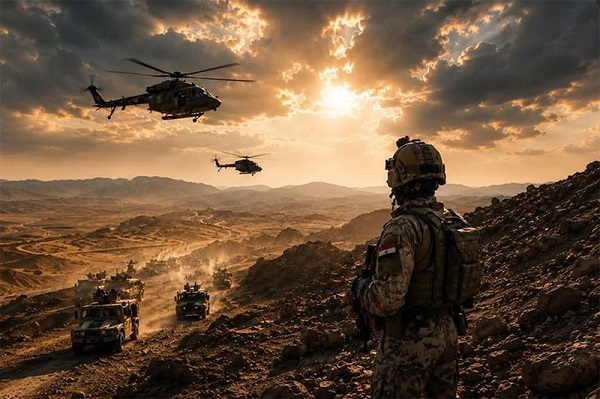
The remarks came as Egypt’s parliament considered an emergency request for authorization to support Saudi Arabia militarily if Riyadh asked for assistance. The House of Representatives held closed-door deliberations on the proposal over two sessions, then postponed a vote until Monday, October 26. The parliamentary process follows a pledge by Egypt’s National Defence Council to provide Saudi Arabia with necessary and possible forms of support to protect its security, stability and territorial integrity.
The constitutional procedure is consequential: Article 152 requires the president to consult the National Defence Council and obtain parliamentary approval by a two-thirds majority before sending the armed forces on a combat mission outside Egypt. The proposed authorization has therefore become both a question of regional policy and a matter for lawmakers to weigh under the country’s constitutional framework.
President El-Sisi had called for an emergency parliamentary session on Saturday, saying Egypt would take measures to protect Saudi Arabia if the kingdom requested them. The presidency’s account of the National Defence Council meeting described the decision as full solidarity with Saudi Arabia and linked the kingdom’s security to Egyptian and wider Arab national security. The council also endorsed continued political and diplomatic efforts aimed at reducing regional tensions.
At the forum, President El-Sisi again stressed that Cairo was not seeking war or an attack on any party. His explicit exclusion of operations against Yemen appears intended to define the scope of the proposed role amid fighting involving Saudi Arabia and Yemen’s Houthi movement. It also underscored the distinction the Egyptian government has drawn between defending Saudi territory and becoming involved in offensive military operations inside Yemen.
The parliamentary debate has exposed differences among Egyptian political groups over how broadly to authorize the president. The Republican People’s Party, Justice Party and Wafd Party have expressed support for the proposed mandate. The Egyptian Social Democratic Party, however, has said it plans to abstain, citing a lack of clarity about the mission’s objectives and potential consequences. Concerns raised in the wider debate include the duration of any deployment, the risks to Egyptian personnel and possible effects on Red Sea and Suez Canal shipping.
That split reflects a difficult balance for lawmakers: Egypt has emphasized solidarity with Saudi Arabia, while some parties have called for greater precision about what the authorization would permit. A broad mandate could give the government flexibility if Saudi Arabia formally requests help, but questions over its limits and duration remain politically significant.
President El-Sisi also restated what he described as core principles of Egyptian foreign policy since 2014: non-interference in other countries’ internal affairs and rejection of conspiratorial policies. He said these principles were intended to support stability and cooperation across the region. His appeal for Arab states to regain stability placed the proposed Saudi support within a wider account of regional security, rather than presenting it as an isolated bilateral commitment.
Religious and diplomatic voices have also called for de-escalation. Al-Azhar has urged the creation of an Arab and Islamic mediation committee, emphasizing dialogue as a means of preventing further conflict. The appeal aligns with the Egyptian government’s stated support for political and diplomatic efforts alongside its pledge of possible defensive assistance.
For now, no military deployment has been announced. Parliament’s delayed vote is the next formal step in determining whether President El-Sisi receives authorization and how lawmakers define it. The president’s statements have established Cairo’s stated boundary: support would be directed at protecting Saudi territory and, if requested, the territory of other Arab states not at attacking Yemen.
