

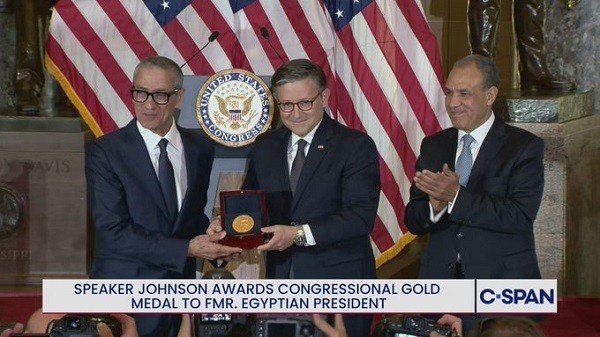
The late Egyptian president Anwar El-Sadat was posthumously awarded the Congressional Gold Medal at a ceremony in Washington on Wednesday, recognizing his role in pursuing peace in the Middle East. His son, Gamal Sadat, accepted the medal on his father’s behalf at the U.S. Capitol, while Egyptian Foreign Minister Badr Abdelatty represented President Abdel-Fattah El-Sisi.
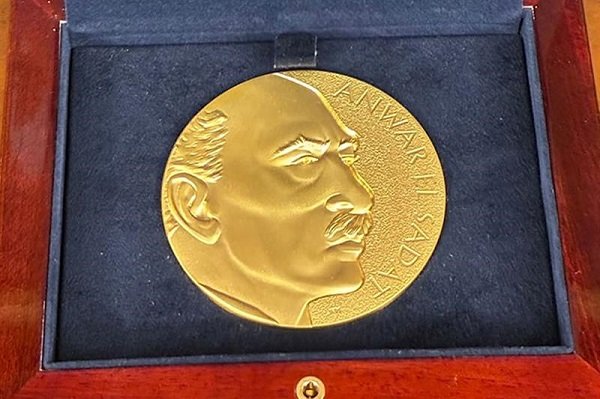
The medal was unveiled ahead of the ceremony in Statuary Hall. Set in a polished mahogany-red case lined with navy suede, it bears a profile of Sadat, including his moustache and swept-back hair, with his name curved around the portrait. The ceremony was scheduled for 3 p.m. local time, or 10 p.m. in Cairo.
The award was authorized by the Anwar Sadat Centennial Celebration Act, signed into law by President Donald Trump on December 13, 2018. The legislation provides for a posthumous medal in recognition of Sadat’s “heroic achievements and courageous contributions to peace in the Middle East.” The House and Senate approved the measure unanimously, according to the supplied account.
Congressional Gold Medals are awarded through legislation passed by Congress. The tradition began in 1776, when the Continental Congress honored George Washington. The medal is widely regarded as Congress’s highest civilian honor, and each award is created through a separate act of Congress.
The Sadat legislation attracted broad bipartisan backing. It was led by Senators Ben Cardin and Orrin Hatch and Representatives Grace Meng and Chris Stewart, and drew 71 Senate co-sponsors and 291 House co-sponsors. The campaign was coordinated by Ezra Friedlander of the Friedlander Group and Shafik Gabr, chairman of the Shafik Gabr Foundation, who jointly led the Sadat Gold Medal Commission.
The ceremony gives formal recognition to Sadat’s place in the history of Middle East diplomacy. As Egypt’s president, he pursued negotiations with Israel that led to the 1978 Camp David Accords and the 1979 Egyptian-Israeli peace treaty. The agreement made Egypt the first Arab country to establish formal peace with Israel. The treaty remains a defining element of Egypt’s foreign policy and a landmark in the region’s modern diplomatic history.
Sadat’s decision to pursue peace was controversial across the region and at home. The treaty brought strategic changes in Egypt’s relations with Israel and the United States, while drawing condemnation from several Arab governments. In October 1981, Sadat was assassinated during a military parade in Cairo by members of an extremist group opposed to his government and its policies. The medal recognizes his peace efforts decades after his death, while the political legacy of those decisions continues to be debated.
Sadat joins a small number of foreign leaders who have received the Congressional Gold Medal. Former Israeli president Shimon Peres received the honor in 2014. Winston Churchill and Nelson Mandela were also among the foreign heads of state previously recognized, while the Dalai Lama and Aung San Suu Kyi received medals in 2007 and 2012, respectively.
The award is distinct from a presidential honor: it represents recognition conferred by the legislative branch and requires Congress to pass a specific law. The process for the Sadat medal began with H.R. 754, which became Public Law 115-310 after clearing the House and Senate and being signed by Trump in December 2018. The law’s stated purpose was to honor Sadat’s contributions to peace, rather than to mark a new diplomatic agreement.
Gamal Sadat delivered acceptance remarks on behalf of his father. Abdelatty, who attended as the representative of the current Egyptian president, delivered Egypt’s remarks. Egypt’s ambassador to the United States, Mohamed Hamdy El Mella, also attended.
The ceremony brought together the legacy of a former Egyptian leader and the current governments of Egypt and the United States in a setting associated with the U.S. Congress. The medal’s presentation does not change the terms of the Egyptian-Israeli treaty or resolve present-day regional disputes. It does, however, place Congress’s recognition of Sadat’s peace initiative on record through one of its most prominent civilian awards.
