

Ahmed Kamel – Egypt Daily News
President Abdel Fattah el-Sisi on Sunday inaugurated the New Delta project along the Sheikh Zayed Axis in Giza Governorate, unveiling one of the country’s most ambitious agricultural and infrastructure undertakings aimed at reshaping Egypt’s food security landscape and expanding sustainable cultivation deep into the desert.
The ceremony marked a major milestone in Cairo’s long-term strategy to reclaim vast stretches of land for agricultural production amid mounting regional and global pressures on food supplies, water resources, and import dependency.
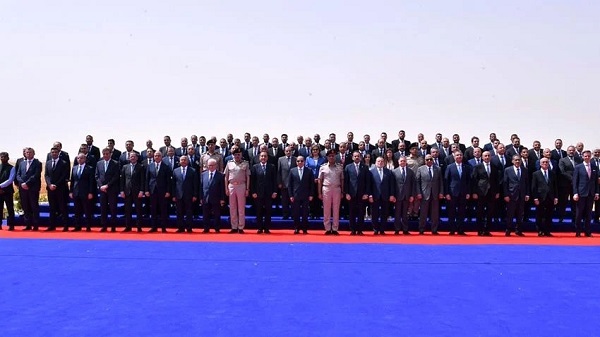
President Sisi was received upon arrival by Prime Minister Mostafa Madbouly alongside senior state officials, military commanders, economic ministers, and representatives overseeing Egypt’s large-scale development projects.
The event opened with a recitation from the Quran followed by a documentary titled “The New Delta,” before Brigadier General Dr. Bahaa El-Ghannam, Executive Director of Egypt’s Future for Sustainable Development Authority, delivered a detailed presentation on the project’s progress and operational structure. During the ceremony, Water Pumping Station No. 3 “Nabaa” was officially inaugurated via video conference, highlighting the enormous engineering network supporting the initiative.
Speaking during the inauguration, President Sisi described the New Delta project as a national achievement made possible through “the grace of God and the efforts of the Egyptian people,” urging citizens to take pride in what he called a transformative development milestone for the country.
The president revealed that the total cost of the project has approached EGP 800 billion, with land preparation costs ranging between EGP 350,000 and 400,000 per feddan. He added that Egypt constructed nearly 12,000 kilometers of roads as part of the wider development plan supporting the agricultural expansion.
At the heart of the project lies one of Egypt’s most difficult strategic challenges: water.
President Sisi explained that the state developed an extensive system to collect agricultural drainage water from the Nile Delta governorates, treat it through advanced triple-treatment facilities, and transport it across two massive channels the Northern Track and the Eastern Track, each extending approximately 150 kilometers.
What makes the operation particularly complex, the president noted, is that water is being transported against the natural geographic slope of the land, requiring the construction of 19 major lifting stations capable of supplying irrigation to nearly 2.2 million feddans of farmland. Egypt also established power stations with a combined generation capacity of around 2,000 megawatts to sustain the system’s enormous energy demands.
President Sisi stressed that the project reflects a broader strategic vision focused on integrating Egypt’s traditional fertile lands in the Nile Valley and Delta with newly reclaimed desert territories.
Under the strategy, conventional crops such as wheat and corn will continue to be cultivated primarily in the fertile clay-rich lands of the old valley due to their higher productivity, while newly reclaimed desert lands will focus on crops better suited for arid environments and capable of delivering higher quality yields, including sugar beet production.
The president said the New Delta project is expected to generate nearly two million sustainable jobs, emphasizing that private companies play a central role in cultivation and agricultural operations. According to President Sisi, around 150 companies are already involved in agricultural production alone, in addition to hundreds of firms participating in supporting sectors tied to the megaproject.
Despite the scale of the initiative, President Sisi acknowledged the continued challenges surrounding food self-sufficiency, noting that Egypt like many countries worldwide, cannot fully achieve self-reliance across all agricultural products due to climatic, environmental, and water-related limitations.
He revealed that Egypt imports between 14 and 17 million tons of animal feed annually in addition to large wheat imports, underscoring the importance of continuing agricultural expansion efforts.
The president also pointed to several parallel agricultural megaprojects underway across Egypt, including developments in Minya, Beni Suef, Kom Ombo, Toshka, East Oweinat, and Sinai, describing development as “an ongoing process with no end to ambition.”
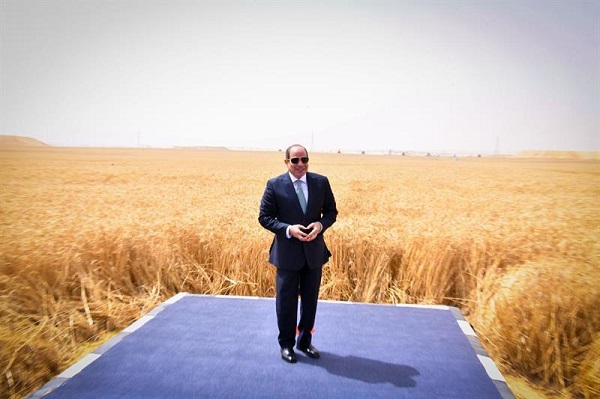
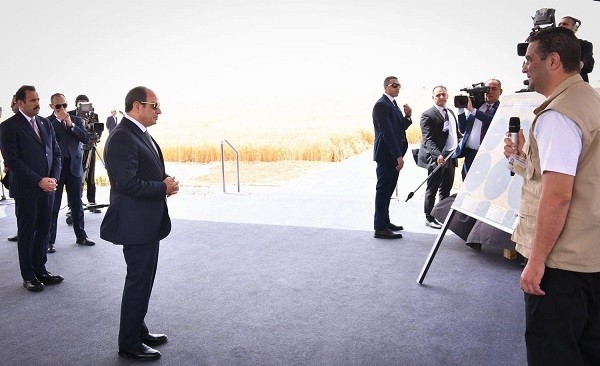
Following the ceremony, President Sisi toured several facilities within the project, including Pumping Station No. 3 Nabaa, industrial operation and control systems, and wheat harvesting sites where he received detailed briefings on wheat productivity and crop quality before concluding the visit by inspecting sugar beet production fields.
