

Ahmed Kamel – Egypt Daily News
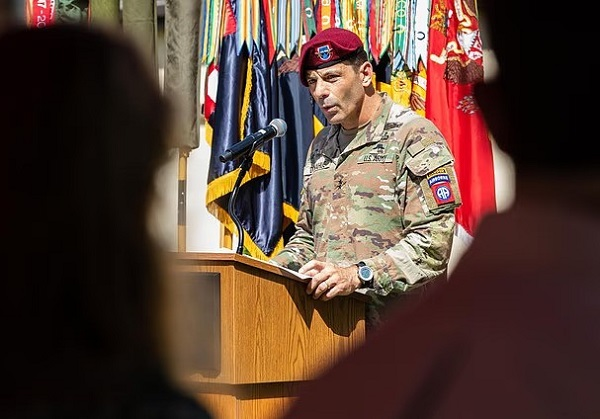
General Chris Donahue abruptly resigned from his high-level military post as Defense Secretary Pete Hegseth initiated a sweeping restructuring plan targeting top-tier American commanders. The decorated four-star officer was scheduled to officially announce his early retirement following intense behind-the-scenes disagreements regarding administrative loyalty protocols.
Donahue previously achieved international recognition as the commander of the elite Delta Force and the final American service member to board evacuation transport during the Afghanistan withdrawal. Military historians frequently reference the iconic night-vision photograph of the general stepping onto a departing aircraft to symbolize the conclusion of that multi-decade foreign deployment.
The immediate catalyst for the sudden resignation stemmed from a confidential proposal to demote the prestige of Donahue’s current strategic assignment. Hegseth finalized plans to downgrade the leadership of United States Army operations in Europe and Africa from a four-star designation to a three-star command structure.
Statutory defense regulations dictate that four-star generals cannot legally occupy positions configured for lower ranks, effectively forcing veteran commanders into early retirement when vacancies disappear. Defense analysts view this structural downgrading as a calculated bureaucratic mechanism designed to sideline highly experienced officers without launching public disciplinary hearings.
The administrative shake-up has significantly intensified across all branches of the armed forces following recent, high-stakes military confrontations with Iranian regional forces. Hegseth frequently asserted that American naval and air forces maintained absolute technical superiority throughout the crisis despite prolonged geopolitical blockades across the strategic Strait of Hormuz.
Supporters of the ongoing restructuring argue that reducing the number of high-ranking generals is a necessary step toward streamlining an excessively bloated defense bureaucracy. However, vocal political detractors warn that purging veteran combat leaders severely compromises national security readiness during a highly volatile period of global instability.
This latest high-profile departure follows a series of unprecedented executive terminations executed by the Department of Defense over the past several months. In April, Hegseth officially removed Army Chief of Staff General Randy George after repeated clashes regarding stalled promotions for frontline personnel.
The administrative purge similarly displaced several other prominent leaders, including the head of Army Transformation and Training Command, General David Hodne, and Chief of Chaplains Major General William Green Jr. These internal changes succeeded the historical ousting of Joint Chiefs Chairman General CQ Brown and Chief of Naval Operations Admiral Lisa Franchetti.
Department files indicate that Lieutenant General Kevin Admiral has been selected as the primary candidate to assume Donahue’s vacated regional responsibilities. This critical leadership transition directly coincides with a broader strategic initiative to scale back long-term military support for traditional European North Atlantic Treaty Organization partners.
The Pentagon formally launched an extensive six-month operational review intended to systematically reduce American troop footprints and heavy hardware deployments across the European continent. Hegseth publicly stated that the long-term objective of this policy is to shift the fiscal and physical burden of regional defense directly onto European allies.
