

Ahmed Kamel – Egypt Daily News
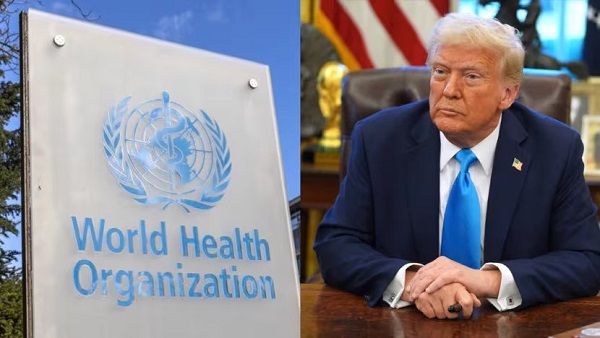
The United States has formally completed its withdrawal from the World Health Organization (WHO), ending a 78-year relationship with the UN’s global health body and triggering warnings from public health experts about weakened disease surveillance, disrupted research cooperation and long-term risks to both American and global health security.
Federal officials confirmed on Thursday that the withdrawal process, announced by President Donald Trump one year ago, has now taken legal effect. The decision follows an executive order signed at the start of Trump’s new term, citing what the administration described as the WHO’s mishandling of the COVID-19 pandemic, its failure to implement “urgently needed reforms,” and its alleged susceptibility to political pressure from member states.
Despite the formal exit, the separation remains incomplete. According to the WHO, the United States still owes approximately $280 million in unpaid membership dues and assessed contributions for 2024 and 2025. While WHO officials say international agreements require those obligations to be settled before withdrawal is finalized, Trump administration officials dispute that interpretation, arguing that no further payments are legally required.
Loss of access to global disease intelligence
Beyond the financial dispute, health experts warn the most immediate consequence of the US withdrawal is the loss of privileged access to global disease surveillance data. By ending official participation in WHO committees, technical working groups and leadership bodies, the US has stepped away from systems that track emerging threats such as influenza variants, Ebola, mpox and polio.
One key concern is the US exit from the WHO’s global influenza surveillance network, which monitors circulating flu strains and informs annual vaccine updates. Public health specialists say this intelligence has historically helped US scientists and pharmaceutical companies stay ahead of outbreaks and rapidly develop vaccines and treatments.
Lawrence Gostin, a public health law professor at Georgetown University, described the move as “the most ruinous presidential decision in my lifetime,” arguing that it will leave the US more vulnerable to future pandemics while undermining global outbreak response efforts. He warned that bypassing the WHO in favor of bilateral data-sharing agreements is unrealistic. “Many emerging viruses are first detected in countries with which the US has limited diplomatic leverage,” Gostin said, questioning whether nations such as China or lower-income states in Africa would share critical data directly with Washington.
Impact on research, vaccines and global programs
The US has long been one of the WHO’s largest contributors, providing not only funding but also technical expertise through agencies such as the Centers for Disease Control and Prevention. On average, the US paid about $111 million annually in mandatory dues and roughly $570 million in voluntary contributions, supporting initiatives ranging from polio eradication and maternal health to cancer guidelines and mental health programs.
Experts say the withdrawal could slow vaccine development and disrupt international research collaborations, particularly in early-stage detection of novel pathogens. Dr. Ronald Nahass, president of the Infectious Diseases Society of America, called the decision “shortsighted, misguided and scientifically reckless,” warning that it weakens coordinated responses to health emergencies that do not respect national borders.
Administration officials argue that the US can maintain global health leadership through direct partnerships with other countries, without relying on the WHO as an intermediary. However, they have provided few details on how many such agreements exist or how comprehensive they are likely to be.
COVID-19 at the center of the dispute
Trump has repeatedly blamed the WHO for errors during the COVID-19 pandemic, including early guidance against mask use and delayed acknowledgment that the virus could spread through the air, a position the organization did not formally revise until 2024. The administration has also criticized the fact that no American has ever served as WHO director-general since the agency’s founding in 1948, despite the scale of US funding and involvement.
Public health experts counter that while the WHO made mistakes, it also coordinated the largest global health response in modern history under intense political and scientific pressure, and that reform would have been more effective from within than through withdrawal.
Legal and diplomatic uncertainty
The withdrawal has also raised constitutional questions. The US joined the WHO through an act of Congress, and some legal scholars argue that leaving the organization should likewise require congressional approval. While the administration maintains that the executive branch has the authority to withdraw, critics say the issue could resurface in future legal or political challenges.
With nearly every country in the world remaining a WHO member, analysts warn that the US decision risks isolating American public health institutions at a time when global cooperation is increasingly critical. As new infectious threats continue to emerge, the long-term consequences of the US exit for both international health systems and America’s own preparedness remain uncertain.
