

Ahmed Kamel – Egypt Daily News
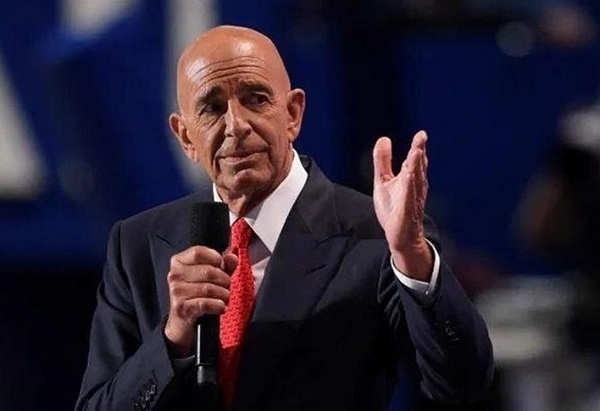
A fresh wave of controversy has emerged following remarks by Tom Barrack, the U.S. ambassador to Turkey and special envoy to Syria. Speaking to reporters outside the White House on Friday, Barrack dismissed the modern Middle East as a political construct, igniting a flurry of questions over how Washington perceives the region and its peoples.
“There is no such thing as the Middle East,” Barrack said. “What you have are tribes, villages, and nation-states created by Sykes-Picot. It’s an illusion to think that 27 artificially created countries with 110 ethnic groups can agree on a single political concept.”
The comments, while brief, triggered significant backlash across diplomatic and media circles. Many observers argue they reflect a deeper and more entrenched American view of the region, one that strips it of historical continuity, cultural identity, and political legitimacy. Critics say Barrack’s framing isn’t just dismissive, but emblematic of a reductionist view that has long shaped U.S. foreign policy.
A Pattern, Not an Outlier?
While some might be tempted to write off Barrack’s remarks as a diplomatic blunder or a personal misstep, others see them as illustrative of a broader mindset within Washington. In an interview with Lebanese journalist and political analyst Khalil Kamarieh commented: “What matters here is not just the words themselves, but the vision they embody. This is how many American officials view us. To them, we are tribes not peoples. Palestinians are referred to as ‘residents’, not a nation. The same goes for Jordanians and Lebanese. In their eyes, we are simply populations scattered across a region, not communities with shared histories and collective identities.”
Kamarieh argues that even the terminology used “Middle East” is loaded with geopolitical intention. “It’s a term coined from a Eurocentric viewpoint,” he said. “Its scope expands or contracts depending on what suits Western or American interests, sometimes it includes Turkey and Iran, other times Israel. The definitions are never neutral.”
The Geopolitics of Fragmentation
Barrack’s statements also draw attention to a more insidious geopolitical strategy: the deliberate framing of the region as a fragmented patchwork rather than a cohesive whole. According to critics, such a view not only simplifies the complex political and cultural landscape of the Middle East, but also paves the way for foreign interference and manipulation.
“The message is clear,” Kamarieh added. “To them, the Arab world and the Middle East are not sovereign entities, but malleable maps. When it suited them, they split Sudan into North and South. In Iraq, they maintained the illusion of unity while ensuring the Kurds couldn’t declare independence, so as not to provoke Turkey. There’s always a strategic interest behind how they handle the region.”
This perceived policy of fragmentation, analysts say, is often aligned with Israeli interests. “There’s a longstanding strategy to keep the region divided, Sunni versus Shia, Druze versus Christian, because a divided Middle East ensures Israel remains the most stable and powerful state, dominating the region both economically and militarily,” Kamarieh noted.
A Broader Diplomatic Dissonance
Barrack’s remarks come amid heightened regional tensions and a growing sense among many in the Middle East that Western powers continue to view the region through a colonial or post-colonial lens. From the Iraq War to the Syrian conflict, many in the Arab world see a pattern of Western engagement that prioritizes short-term strategic gains over long-term stability or genuine partnership.
What’s more, the seeming lack of sensitivity in Barrack’s comments underscores a persistent gap between American rhetoric and policy. While the U.S. frequently promotes the language of democracy, sovereignty, and peace, its approach on the ground often tells a different story, one marked by military interventions, shifting alliances, and a selective reading of international law.
A Moment of Reflection?
Whether Tom Barrack’s words were a misstep or a revealing slip, they serve as a sobering reminder of the enduring disconnect between how the region sees itself and how it is perceived in Western capitals. At a time when the Middle East is grappling with wars, economic crises, and political upheavals, the need for nuanced, respectful, and informed engagement is more pressing than ever.
Diplomatic language matters especially when it comes from the mouth of a U.S. envoy. If nothing else, Barrack’s remarks should prompt a re-examination not just of the words used by American officials, but of the frameworks and assumptions that continue to shape U.S. policy in one of the world’s most complex and misunderstood regions.
