

Ahmed Kamel – Egypt Daily News
A symbolic parade under heavy security, but with visible changes in tone and scale:
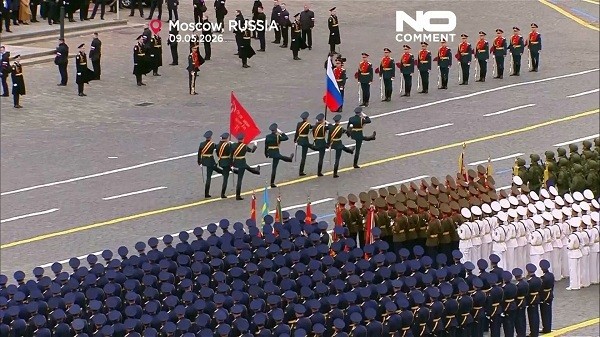
Russia marked Victory Day in Moscow’s Red Square on Saturday with a noticeably restrained military parade, as President Vladimir Putin used the occasion to project confidence in the ongoing war in Ukraine while overseeing an event stripped of its usual display of heavy military hardware.
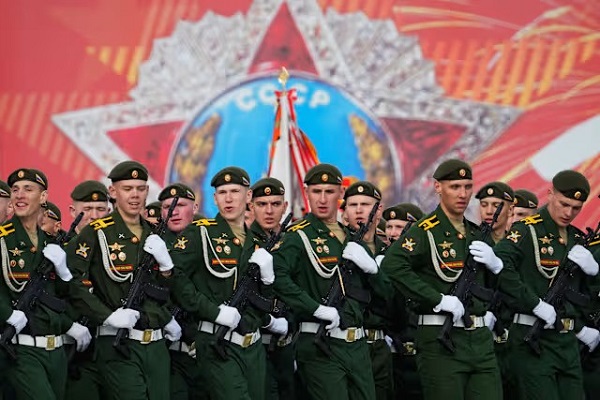
For the first time in nearly two decades, tanks, missile systems and other major equipment were absent from the parade, a striking departure from a ceremony long used to showcase Russia’s military strength.
Security lockdown and reduced military display:
The capital was placed under tight security, with authorities imposing broad restrictions across central Moscow. Mobile internet and messaging services were disrupted, while large areas around the Kremlin were largely emptied ahead of the event.
Officials said the changes were driven by security considerations linked to the conflict in Ukraine, with state media suggesting that equipment was needed at the front rather than for ceremonial display.
Instead of armored columns, the parade featured marching units and a limited aerial flyover.
Putin frames war as confrontation with NATO-backed forces:
In his address, Putin praised Russian troops fighting in Ukraine, portraying the conflict as a direct confrontation with Western powers.
He said Russian forces were “facing an aggressive bloc supported by NATO,” while insisting they were advancing despite battlefield pressure.
“Victory will be ours,” he told the assembled troops on Red Square, reinforcing a narrative he has consistently used since the start of the invasion.
Foreign participation highlights shifting alliances:
This year’s event included a small group of foreign leaders and delegations, among them representatives from Belarus, Kazakhstan, Uzbekistan, Laos, and Malaysia. For the first time, North Korean troops also took part in the parade, underscoring deepening military ties between Moscow and Pyongyang.
The limited attendance contrasted with previous years, when more prominent international figures were present.
Ceasefire backdrop shaped by competing claims:
The parade took place amid a brief, contested ceasefire period that followed diplomatic pressure and parallel announcements from Moscow and Kyiv.
U.S. President Donald Trump had said a short truce could open the way toward ending the war, while Ukrainian President Volodymyr Zelenskyy confirmed adherence to a pause in hostilities tied to prisoner exchanges.
Despite the announcements, both sides accused each other of violations in the days leading up to the ceremony.
War narrative dominates Kremlin messaging:
The Kremlin continues to frame Victory Day as a central pillar of national identity, linking World War II memory to the current conflict.
Putin invoked the Soviet victory over Nazi Germany to reinforce themes of sacrifice, unity, and endurance, casting Russia’s current military campaign as a continuation of historic struggles.
A reduced parade with political messaging intact:
While visually scaled down, the event retained its political purpose: reinforcing domestic unity and projecting resilience amid a prolonged war.
The absence of heavy weapons highlighted the practical pressures of ongoing combat, but the rhetoric from the Kremlin remained firmly assertive, signaling no shift in Russia’s strategic direction.
