

Ahmed Kamel – Egypt Daily News
The confrontation between Iran and the United States entered a dangerous new phase on Wednesday as Tehran launched missiles and drones at American military facilities across the Gulf, hours after U.S. forces carried out airstrikes inside Iranian territory.
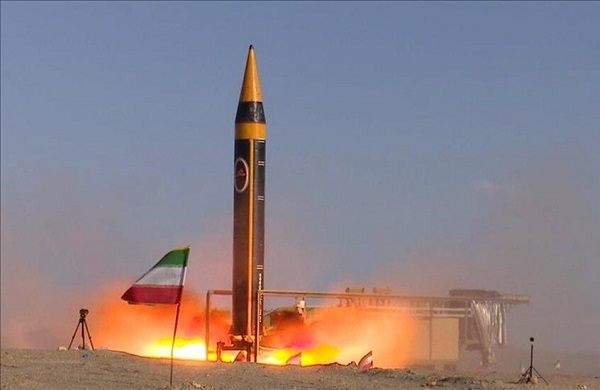
Iran’s Revolutionary Guard announced that it had targeted American bases in Bahrain and Jordan in what it described as a direct response to U.S. attacks on military infrastructure near the Strait of Hormuz. Gulf states activated air defenses as the strikes unfolded, raising fears that the conflict could spill into a broader regional war.
Authorities in Bahrain said their defense forces intercepted multiple incoming missiles and drones, accusing Iran of targeting civilian areas in the kingdom. The attacks were aimed at facilities connected to the U.S. Fifth Fleet, one of Washington’s most important naval commands in the Middle East.
Jordanian officials reported that five missiles launched from Iran were shot down before reaching their intended target. Tehran said the missiles were directed at Muwaffaq Salti Air Base, a military installation that has hosted American fighter aircraft and support personnel. Kuwait also confirmed that its air defense systems were engaged against what it described as hostile aerial threats.
The exchange followed a wave of U.S. airstrikes against Iranian military assets earlier in the day. U.S. Central Command said American fighter aircraft attacked air-defense systems, radar installations, surveillance facilities and command centers after Washington blamed Iran for the downing of a U.S. Army Apache helicopter.
American officials portrayed the operation as a limited military response rather than the beginning of a wider campaign. According to U.S. officials, the Trump administration believes the strikes will not derail ongoing diplomatic efforts aimed at ending months of conflict across the region.
Tehran responded with threats of further retaliation. Iranian Foreign Minister Abbas Araghchi warned that foreign military forces operating near Iran would remain vulnerable, declaring that Iranian forces would not leave any attack unanswered.
Beyond the military escalation, the fighting is increasingly affecting civilian infrastructure. Iranian media reported that missile strikes hit two major water reservoirs in Hormozgan province near the Strait of Hormuz, cutting drinking water supplies to thousands of residents.
According to officials from the Hormozgan Water and Wastewater Company, the damaged facilities served the town of Kouhestak and ten surrounding villages. The destruction reportedly left around 20,000 people without reliable access to drinking water.
Emergency crews have begun delivering water through tanker trucks while temporary pumping systems are being installed to restore service. Iranian authorities estimated infrastructure losses at roughly 140 billion tomans, equivalent to nearly $800,000.
The latest exchange marks one of the most significant direct confrontations between Tehran and Washington since the conflict erupted earlier this year. What began as a war centered on Iran and Israel is increasingly drawing in neighboring states and American military forces stationed across the Gulf.
The growing instability has also rattled global markets. Oil prices continued climbing amid concerns over the security of shipping routes through the Strait of Hormuz, one of the world’s most critical energy corridors. Brent crude traded above $91 per barrel on Wednesday, extending gains that have exceeded 25 percent since the conflict began.
Diplomatic efforts to transform April’s fragile ceasefire into a permanent settlement now face renewed uncertainty as military operations expand and regional powers become more deeply involved in the fighting.
