

Ahmed Kamel – Egypt Daily News
President Donald Trump has signaled that Iran could be allowed to retain part of its ballistic missile arsenal under a forthcoming peace agreement, a position that would mark one of the most significant departures from decades of US policy toward Tehran. The comments have sparked immediate debate in Washington, where successive administrations have long treated Iran’s missile program as a non-negotiable security threat.
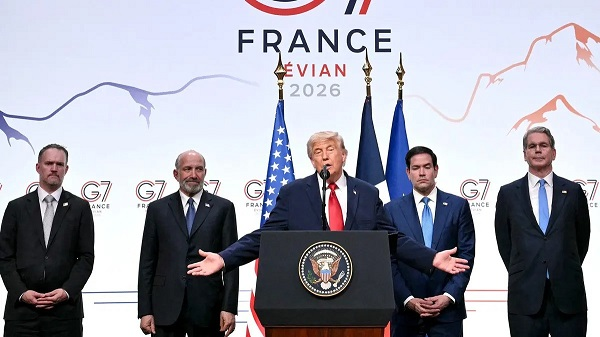
Speaking to reporters during the G7 summit in France, Trump suggested that demanding the complete elimination of Iran’s conventional missile capabilities was unrealistic. He argued that regional powers maintain similar military assets and questioned whether Tehran should be uniquely prohibited from possessing them.
“They got to have some,” Trump said when asked whether Iran would be permitted to keep missiles under the proposed agreement. The remark represents a dramatic shift from years of American policy that sought either severe restrictions or the complete dismantling of Iran’s ballistic missile infrastructure.
Trump also downplayed the strategic significance of conventional missiles compared with nuclear weapons, describing them as a lesser threat. His comments contrasted sharply with previous US positions that identified Iran’s missile program as one of the primary drivers of instability across the Middle East.
The President further claimed that Iran’s missile capabilities had already been significantly degraded during recent military operations. According to Trump, roughly 85% of the country’s missile inventory has been neutralized, while many of the remaining systems are stored underground and difficult to deploy.
The emerging agreement has drawn particular attention because missile restrictions have historically been among the most contentious issues in negotiations with Tehran. Critics of the 2015 nuclear deal repeatedly argued that excluding ballistic missiles from the framework left a major security gap that Iran later exploited.
Trump himself was among the most vocal opponents of that agreement during his first term in office. After withdrawing the United States from the deal in 2018, he launched a maximum-pressure campaign that demanded far broader restrictions on Iran’s military and missile programs.
His latest comments therefore represent not only a break from longstanding bipartisan policy but also a reversal of his own previous position. The apparent willingness to accept a limited Iranian missile capability has become one of the most controversial aspects of the proposed diplomatic roadmap.
The debate comes as Washington and Tehran move toward formalizing a memorandum of understanding designed to reduce tensions following months of escalating conflict. The framework is expected to trigger a 60-day negotiating period aimed at producing a broader and more comprehensive agreement.
Beyond the nuclear issue, the proposed deal reportedly addresses a wide range of regional flashpoints, including sanctions relief, maritime security, the Strait of Hormuz, Lebanon, and the future role of US forces in the Middle East. The scope of the negotiations suggests both sides are seeking a wider regional settlement rather than a narrowly focused nuclear accord.
Another provision reportedly under discussion involves the creation of a reconstruction and development fund that could reach $300 billion. Supporters view the proposal as a mechanism to stabilize Iran’s economy and encourage long-term compliance, while critics argue it risks rewarding Tehran with massive financial incentives in exchange for limited concessions.
With negotiations entering a critical phase, Trump’s missile comments are likely to become one of the defining political battles surrounding the agreement. Whether the proposal ultimately delivers regional stability or triggers a new wave of criticism may depend on how much of Iran’s military infrastructure remains untouched under the final deal.
