

The Presidency
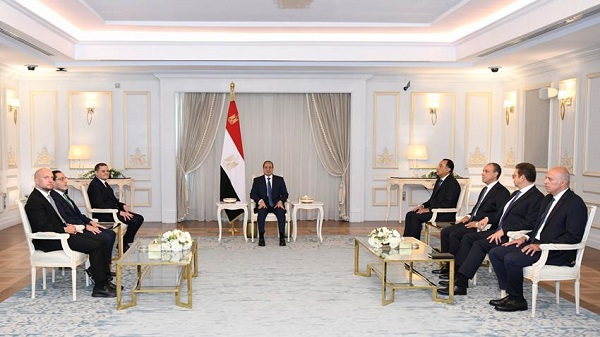
Today, President Abdel Fattah El-Sisi received in El Alamein Libyan Prime Minister of the Government of National Unity Abdulhamid Dbeibah. Prime Minister Dr. Moustafa Madbouly, Minister of Foreign Affairs, International Cooperation, and Egyptian Expatriates Dr. Badr Abdelatty, and Director of the General Intelligence Service Minister Hassan Rashad were present, along with National Security Advisor Ibrahim Dbeibah and Minister of State for Communication and Political Affairs Walid Al-Lafi from the Libyan side.
The Spokesman for the Presidency, Ambassador Mohamed El-Shennawy, stated that President El-Sisi welcomed Mr. Dbeibah’s visit to Egypt, stressing the historical and close ties that Egypt and Libya share. The President emphasized the need to further strengthen these relations across various fields to achieve the interests of the two peoples, and boost years of ongoing cooperation.
The President affirmed that Egypt remains committed to Libya’s stability and prosperity, according great importance to supporting its peace, stability, unity and territorial integrity.
The President noted the importance of advancing cooperation in promising sectors, particularly electricity, energy, infrastructure, and reconstruction, as well as increasing trade and investment between the two countries.
The Libyan Prime Minister of the Government of National Unity expressed his appreciation for visiting Egypt and meeting the President and emphasized the pivotal nature of the relations between Egypt and Libya. He also noted the importance of further enhancing relations in all priority areas to achieve development and prosperity in both countries. In the same vein, Mr. Dbeibah commended Egypt’s position in support of Libya’s security and stability, affirming that this reflects the historical ties between the two countries and peoples.
The meeting addressed the latest regional and international developments. Both sides explored opportunities for joint coordination to maintain regional peace and stability. They emphasized the importance of resolving various conflicts in the region through dialogue and peaceful means to achieve regional peace. In this regard, both sides agreed to intensify ongoing consultations and coordination between the two countries to address shared challenges.
