


Ahmed Kamel – Egypt Daily News
The United States Department of State has officially issued an urgent global security directive commanding all American citizens currently residing in the Middle East to immediately evacuate the region via available commercial transit routes. Diplomatic envoys confirmed the emergency advisory responds to an imminent military escalation, with Washington actively finalizing plans to launch a massive wave of retaliatory airstrikes against the Islamic Republic of Iran as early as this weekend.
President Donald Trump explicitly broadcasted the looming offensive from the Oval Office, delivering a strict ultimatum that the United States military is prepared to strike Iranian defense assets exceptionally hard. Senior Pentagon officials cautioned that while the final scope of the joint combat package could still be altered, combat flight wings are locked and loaded to execute the air campaign unless Tehran abruptly halts its regional proxy actions.
United States Embassy in Cairo Elevates Security Protocols and Issues Direct Warnings to Expats
The United States Embassy in Cairo has significantly elevated its operational defense posture, coordinating closely with regional diplomatic networks to track the rapidly escalating crisis. Security envoys stationed at the Cairo mission issued a targeted alert to the substantial American expatriate and diplomatic community residing across Egypt. The embassy explicitly urged citizens to maintain heightened vigilance, re-verify personal emergency contingency plans, and prepare for sudden commercial flight cancellations or regional airspace closures.
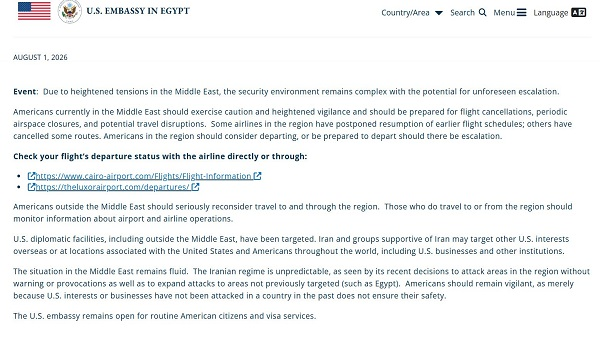
The heightened alert from the Cairo embassy comes at a highly delicate diplomatic window for Egypt, which has served as a central hub for regional ceasefire negotiations and maritime transit mediation. American security officers in Cairo are continuously reviewing safety matrices for civilian institutional sites, noting that Western commercial interests and diplomatic facilities both inside and outside the immediate conflict zones could face asymmetric reprisal risks from hostile regional proxies.
Kuwaiti Infrastructure Targeted by Drone Waves as Tehran Threatens Allied Host Nations
The regional security environment fractured further when Kuwaiti national defense authorities reported a series of hostile Iranian drone incursions targeting local infrastructure hubs. The aerial bombardment materializes immediately after the Islamic Revolutionary Guard Corps issued a chilling warning notice to all adjacent Arab governments that host active United States military installations.
Tehran formally declared that any sovereign territory utilized by American warplanes to launch strikes against Iran will be systematically categorized as a legitimate military target for ballistic annihilation. The direct threat has sent shockwaves through Gulf capital hubs, forcing regional security ministries to aggressively review their local air defense matrices to shield vital energy corridors from asymmetric missile strikes.
Diminishing Munitions Stockpiles and High Transit Costs Drive Severe Market Inflation Alarms
The rapid unravelling of Middle Eastern diplomatic frameworks has triggered widespread panic across international maritime registries and corporate investment boards. Financial experts warn that the escalating warfare and ongoing blockades across the Strait of Hormuz have pushed global crude oil prices past the one-hundred-dollar threshold, driving consumer automotive gasoline costs to a devastating national average of four dollars and nine cents.
Concurrently, senior defense planners have raised severe internal alarms regarding the United States military’s dangerously low stockpiles of Patriot missile interceptors, which have been rapidly depleted by continuous drone tracking operations over the past two weeks. As American families rush to secure remaining commercial airline tickets before prospective airspace closures halt local airport operations, international risk analysts warn that a prolonged weekend bombing campaign will permanently collapse regional trade connectivity.
