

Ahmed Kamel – Egypt Daily News
Washington has launched a sweeping economic campaign against Iran, imposing sanctions on 60 individuals, companies and vessels linked to Tehran’s nuclear, missile and energy programs. The Trump administration seeks to intensify pressure on the Iranian government and disrupt the financial networks that support it.
The US Treasury Department said the measures were introduced at the direction of President Donald Trump and would involve multiple federal agencies. The campaign targets Iranian institutions, commercial intermediaries and international networks accused of helping Tehran export oil, move money and evade existing sanctions.
Alongside the new designations, the Treasury suspended several general licenses that had allowed limited financial transfers involving Iran. The decision is expected to further restrict the channels available to Iranian institutions and companies seeking access to foreign currency and international banking services.
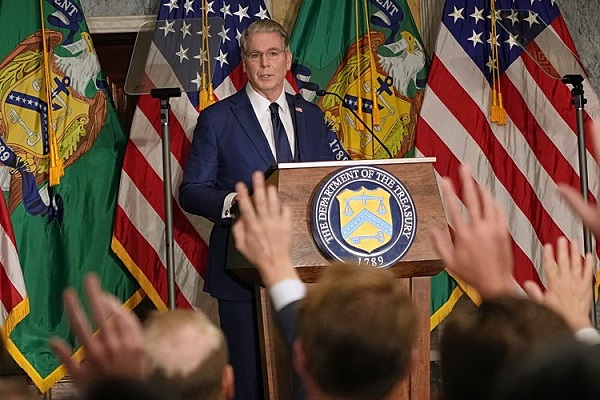
Treasury Secretary Scott Bessent said Washington was working to persuade governments around the world to reduce or end their economic relations with Tehran. He said President Trump had been contacting foreign leaders and urging them to take action against Iranian banking, shipping and energy networks.
The administration has given governments a limited period to end activities identified by Washington, including the operation of overseas branches of Iranian banks. Bessent warned that countries and companies that failed to comply could face unilateral US action and secondary sanctions.
He said entities involved in laundering money for Iran risked losing access to the dollar-based financial system, one of the most powerful tools available to Washington. The threat is aimed not only at Iranian institutions but also at foreign banks, companies and intermediaries that continue to process transactions for Tehran.
“No one is beyond the reach of US sanctions,” Bessent said, emphasizing the administration’s intention to pursue the campaign across national borders and economic sectors.
The Treasury secretary identified five areas that he said Iran uses to preserve its economic activity abroad: digital assets, technology, gold, aviation and maritime shipping. US officials also said they had mapped the networks used to transport Iranian oil, arrange payments and obscure the identities of the companies involved.
Bessent compared the economic campaign to the Allied landings in Normandy during the Second World War, describing the sanctions effort as a coordinated offensive that would combine financial pressure with America’s military capabilities. He justified the escalation by accusing Iran of responsibility for the deaths and injuries of American citizens and service members. The secretary urged countries that continue to conduct business with Tehran to recognize the seriousness of Washington’s position and respond quickly to its demands.
The administration’s next steps could involve a major financial institution. Bessent said a large institution would face Iran-related sanctions before the end of the week, although he did not identify the organization or specify the nature of the alleged violations.
The prospect of sanctions against Chinese banks or shipping companies is likely to be closely watched. China has remained Iran’s principal customer for crude oil and has historically accounted for the overwhelming majority of Iranian oil exports. Any direct action against Chinese entities could therefore create a new source of tension between Washington and Beijing.
Bessent declined to say whether specific Chinese companies had already been selected as targets. He warned, however, that every country and entity continuing to deal with Iran should be prepared for possible sanctions. The Treasury secretary also pointed to the United Arab Emirates’ decision to halt commercial dealings with Iran the previous week. He suggested that the move was probably influenced by US pressure and predicted that other governments could adopt similar measures.
Despite the administration’s aggressive language, Bessent said Washington was not seeking to destabilize the international financial system. He maintained that governments were being given an opportunity to change their policies before the United States imposed additional secondary sanctions.
Iran has rejected the US campaign, describing it as economic warfare and dismissing Washington’s ability to force other countries to abandon their commercial ties with Tehran.
Iranian Parliament Speaker Mohammad Bagher Ghalibaf said the United States could not compel Iran’s trading partners to comply with its demands. He argued that countries maintaining economic relations with Tehran had made clear, both publicly and through private communications, that they would not be intimidated by US threats.
Deputy Foreign Minister Kazem Gharibabadi questioned whether the new campaign reflected an admission that earlier US efforts had failed. He noted that Washington had previously claimed to have weakened Iran’s military capabilities, while now presenting a massive financial campaign as necessary to confront Tehran.
Mohsen Rezaei, a senior Iranian security official, issued a direct warning that Iran could retaliate if the pressure campaign continued. He said Tehran would prevent the export of oil through the Strait of Hormuz or other Gulf routes and would consider any country that participated in the sanctions campaign or supported it to be committing an act of war.
The latest measures represent another phase in Washington’s long-running effort to isolate Iran economically. The United States imposed extensive sanctions during Trump’s first administration under its “maximum pressure” strategy and introduced further restrictions this year under a separate initiative described as “Operation Economic Fury.”
The effectiveness of the new campaign remains uncertain. Iran’s economy has already endured years of restrictions on oil exports, banking and international trade. Tehran has developed alternative payment channels, relied heavily on regional intermediaries and expanded its economic relationship with China and other countries willing to continue trading with it.
The campaign could also create risks for the United States. Restrictions affecting Iranian oil exports may place upward pressure on global energy prices, while sanctions against Chinese companies could further strain relations between Washington and Beijing. Those tensions would be especially sensitive ahead of an expected meeting between Trump and Chinese President Xi Jinping in Washington next month.
The financial measures are being introduced as the United States faces rising costs connected to the conflict. Defense Secretary Pete Hegseth has estimated that US military operations have cost $37.5 billion, while broader estimates of the economic impact have reached approximately $150 billion.
The conflict is also becoming a political liability for Trump ahead of the November midterm elections. Declining approval ratings, higher fuel prices and turbulence in the US bond market have increased pressure on the administration. Economists have linked part of the market instability to the economic consequences of the conflict, prompting the Treasury Department to take extraordinary measures.
Whether the new sanctions will force Tehran to alter its policies or instead deepen the confrontation remains unclear. For now, Washington is signaling that it intends to expand the campaign, while Iran is warning that further pressure could trigger a wider regional and economic crisis.
