

Ahmed Kamel – Egypt Daily News
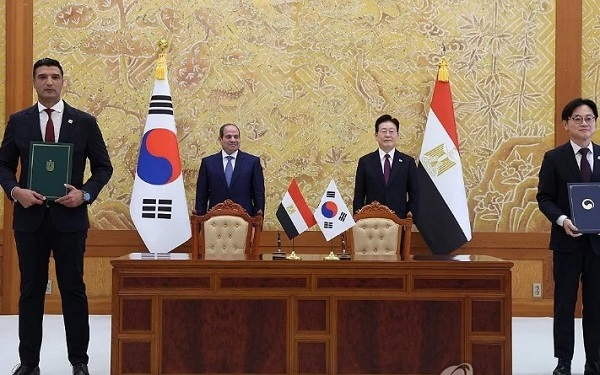
Egypt and South Korea have set out a wider agenda for cooperation, signing or exchanging 12 agreements during a Seoul summit and formally launching negotiations on a Comprehensive Economic Partnership Agreement. The package reaches beyond trade, spanning industrial development, clean energy, digital technology, education, cultural exchange and social security.
The summit between President Abdel Fattah el-Sisi and South Korean President Lee Jae Myung also elevated relations to a strategic partnership. Both governments described the change as a foundation for closer work across economic and industrial sectors, as well as defense and technology. The agreements were announced during President el-Sisi’s state visit to South Korea, his first visit to the country since 2016.
The CEPA negotiations are the most consequential part of the economic agenda. A comprehensive economic partnership agreement can cover more than tariffs, including trade in services, investment, industrial cooperation and supply chains. The two leaders had agreed to pursue such a deal when Lee visited Egypt in November 2025. The new joint declaration moves that intention into formal negotiations; South Korean reporting says the countries aim to begin the first formal round in the first half of 2027.
For Egypt, the negotiations offer a chance to attract investment and expand access to Korean expertise and production networks. For South Korea, Egypt’s position linking the Middle East and Africa, together with its large domestic market, makes it a potential base for companies seeking regional opportunities. Those benefits are not automatic: the eventual terms, implementation and ability to turn memorandums into funded projects will determine how much the agreements change commercial activity.
The signed documents address practical barriers as well as long-term industrial goals. A social security agreement is intended to reduce the risk that employees temporarily sent to the other country will have to pay pension contributions in both places. Eligible posted workers may be exempt from contributions in the host country for up to five years, while insurance periods accumulated in Egypt and South Korea can be combined when determining eligibility for pensions and related benefits. The arrangement could make cross-border assignments easier for workers and employers.
Industrial cooperation includes shipbuilding and maritime affairs. South Korea has substantial shipbuilding expertise, while Egypt’s location and maritime links give it a strong interest in developing port and marine industries. The two sides have also agreed to cooperate on electricity infrastructure and clean energy. Those areas are linked: power-system improvements can support more reliable electricity supplies, while clean-energy projects can help both countries pursue changes in how energy is produced and used.
The agreements also place digital development on the bilateral agenda. A memorandum on information and communications technology covers cooperation in areas including high-speed internet, artificial intelligence, cybersecurity and digital transformation. It provides for exchanges of technical knowledge and personnel, joint research and links between companies. If carried through, that cooperation could connect government digitalization and communications infrastructure with commercial opportunities for technology firms.
Education and culture provide another dimension to the relationship. The countries agreed to cooperate in higher education and designate 2027 as a year of cultural exchange. The Grand Egyptian Museum signed separate cooperation agreements with South Korea’s National Museum of Korea and National Agricultural Museum of Korea. These partnerships create channels for museums and institutions to share expertise and develop exchanges around cultural collections and heritage.
Defense industry cooperation was also discussed at the summit. The leaders cited joint production of K9 self-propelled howitzers as an existing model, and Lee expressed support for expanding cooperation beyond equipment exports to include local production and technology transfer. That approach aligns with Egypt’s broader interest in building domestic industrial capacity, though any expansion would depend on future agreements and investment.
The package is broad, but its significance will depend on what happens after the summit. The CEPA negotiations must resolve the details of market access and cooperation; ministries and institutions must translate memorandums into working programs; and companies must decide whether the commercial conditions justify investment. Still, the agreements establish a framework that ties trade discussions to specific areas of cooperation, from power systems and shipbuilding to digital skills, pensions and museum collaboration.
Together, the new partnership and 12 agreements mark a move from diplomatic commitments toward a more structured relationship. The next measure of progress will be whether the two governments can convert that framework into concrete projects, stronger business links and practical benefits for workers and institutions in both countries.
