

Ahmed Kamel – Egypt Daily News
A road bicycle chosen for President Abdel-Fattah el-Sisi and a performance of a beloved Egyptian song by Korean children brought an informal note to the official welcome for his visit to Seoul.
South Korean President Lee Jae Myung selected the bicycle as a gift in recognition of el-Sisi’s interest in cycling and his support for using bicycles to promote public health. The choice stood apart from the usual diplomatic gifts, reflecting a personal interest rather than a national symbol or ceremonial keepsake.
The announcement of the gift came from South Korea’s presidential office, which said Lee would present the road bike during the visit. The public account described the selection and its rationale, but did not document the moment of the handover.
The welcome ceremony offered another gesture intended to make the visit distinctive. A children’s choir from the city of Gunpo performed “Feha Haga Helwa,” a popular Egyptian song, in Arabic for the two presidents. The performance placed a familiar piece of Egyptian culture at the center of a formal state occasion in the South Korean capital.
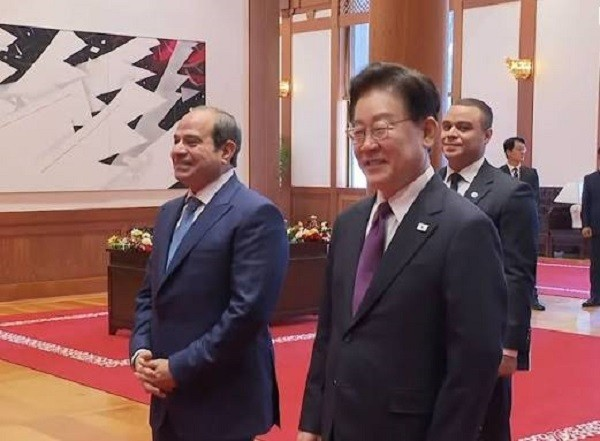
The Egyptian presidency said the ceremony also included the national anthems of both countries and an honour guard. President El-Sisi signed the visitors’ book, and the presidents posed for an official photograph. After the music, he spoke with the children and praised their performance before moving on with the scheduled program.
The song’s appearance in the welcome ceremony was more than a musical interlude. Sung in Arabic by young performers in South Korea, it offered a direct expression of hospitality and gave the event a cultural dimension alongside the formal protocol. The performance also created a moment of connection between the visiting president and the children, who greeted him in the language of his country.
Following the welcome, President Lee and President el-Sisi held a private meeting before broader talks involving delegations from both countries. The discussions covered bilateral relations, and the two leaders witnessed the signing of agreements and memorandums of understanding. They later held a joint press conference, followed by a luncheon hosted by President Lee for President el-Sisi and the Egyptian delegation.
The contrast between the bicycle and the formal agreements captured two sides of a presidential visit. The gift acknowledged an individual interest, while the official talks addressed the practical work of strengthening relations between Egypt and South Korea. The ceremony’s music, meanwhile, offered a visible sign of cultural outreach.
Such personal touches can help give state visits a warmer public image, but the substantive outcomes are usually measured through the meetings and agreements that follow. The two presidents’ discussions and the documents signed by their delegations formed the diplomatic core of the Seoul visit. Details of the agreements were not included in the announcement about the bicycle and the performance.
For South Korea, hosting President el-Sisi provided an opportunity to reinforce engagement with Egypt at the highest political level. For Egypt, the visit brought its president together with his South Korean counterpart for talks and a series of official events. The ceremonial welcome framed that agenda with gestures tailored to the visitor: a gift linked to cycling and a song chosen from Egypt’s popular repertoire.
The bicycle may be a modest object compared with the policy issues discussed by the two governments, but its selection conveyed an intentional message of attentiveness. Likewise, the choir’s Arabic performance turned a standard welcome into a moment designed specifically for the Egyptian guest.
Together, the gestures gave the Seoul visit a memorable opening: one rooted in personal recognition, the other in cultural familiarity. Behind them, the formal meetings continued the broader effort to deepen ties between the two countries through dialogue and agreements.
