

Ahmed Kamel – Egypt Daily News
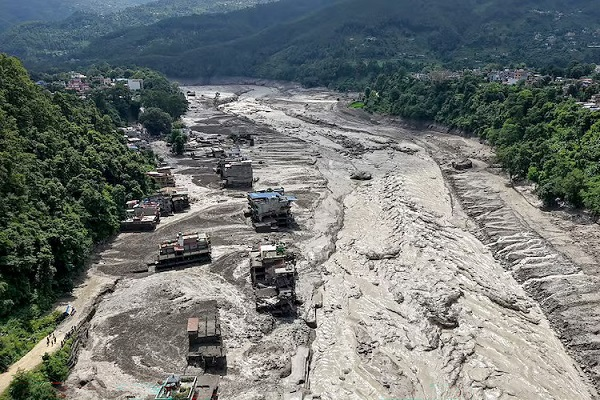
Severe flooding in northern Nepal has killed more than 150 people and left hundreds missing after a landslide triggered a sudden surge of water near the country’s border with China, officials said.
The disaster struck in Rasuwa district at approximately 8:40 a.m. local time on Wednesday. The affected area is located near the Rasuwagadhi border crossing, a mountainous route connecting Nepal with Tibet. Rescue teams have been working to reach isolated communities and determine the whereabouts of residents, tourists and travelers who were in the region when the flooding began.
Nepali police reported that 157 people had been found dead across the affected areas. Chinese state media separately reported three deaths, although authorities said the figures remained subject to change as search teams continued their work and officials attempted to identify victims.
The flooding was reportedly linked to a landslide approximately 20 kilometers northeast of the Rasuwagadhi border post. The landslide sent large amounts of earth and debris into waterways, causing flood conditions that damaged roads, disrupted transport links and cut off access to several parts of the district.
The scale of the disaster remained unclear as emergency workers faced difficult weather and challenging terrain. Nepal’s Prime Minister’s Office said at least 403 foreign nationals and 93 Nepali tourists were reported missing. Chinese media cited a lower figure of 265 missing people, reflecting the difficulty of confirming the identities and locations of those affected.
Among those believed to be missing were tourists from the United States, India, Malaysia, Britain, South Africa, the Netherlands and Australia. At least 47 American tourists were included in preliminary reports about missing foreign nationals.
Fishtail Tours and Travel, a Nepali tourism company, confirmed that three US citizens traveling with one of its groups were unaccounted for. The company said efforts to locate and rescue the tourists were underway but did not provide details about their last known location or condition.
The Nepal Tourism Board said that tourism officials, local authorities and law enforcement agencies were coordinating efforts to verify the safety of visitors and travelers who had been in, or were passing through, the affected region. Officials warned that early figures could change as communications were restored and additional reports arrived from remote communities.
Nepali authorities deployed 656 police personnel to assist with rescue and relief operations by Wednesday evening. Their duties included searching for survivors, recovering bodies, clearing debris and helping residents move away from areas at risk of further flooding or landslides.
The United States said it was monitoring the situation closely. A State Department spokesperson said officials in Washington and Kathmandu were in contact with the Nepalese government and that the United States was prepared to provide assistance if requested.
The US Embassy in Kathmandu expressed sorrow over the loss of life and the destruction caused by the disaster. It said it was working to account for American citizens who may have been affected and urged US nationals in Nepal to follow instructions issued by local officials.
Americans in or near the affected areas were advised to monitor local news, avoid travel to dangerous locations and contact the embassy if they required urgent help. Officials cautioned that damaged roads and unstable slopes could make movement particularly hazardous.
Rescue operations were also hampered by poor weather. Three Nepalese army helicopters attempted to fly toward the disaster zone on Wednesday but were forced to turn back because of unfavorable conditions between Kathmandu and the flooded areas, according to Sunil Sharma, a spokesperson for the Nepal Tourism Board.
Sharma said authorities hoped aircraft would be able to resume rescue and relief flights the following day if visibility and weather conditions improved. Helicopters are considered essential for reaching communities that cannot be accessed by road, particularly where bridges have collapsed or routes have been buried by mud and rock.
The United Nations and Nepalese authorities have long warned that the country’s mountainous landscape leaves many communities vulnerable to landslides, flash floods and other natural disasters. Heavy rain, unstable slopes and limited road access can turn localized incidents into major emergencies within minutes.
Nepal’s Prime Minister’s Office expressed condolences to the families of those killed in Rasuwa and neighboring Nuwakot. The government paid tribute to the victims and said rescue agencies would continue working to locate missing people and provide support to survivors.
With the death toll still being assessed and hundreds of people unaccounted for, authorities warned that the full impact of the flooding may not be known until rescue teams reach the most isolated areas.
