

Ahmed Kamel – Egypt Daily News
Energy ministers from Egypt, Cyprus and Greece have agreed to intensify work on turning East Mediterranean gas opportunities into cross-border projects, with a focus on bringing Cypriot offshore reserves to market and connecting regional supply to European buyers.
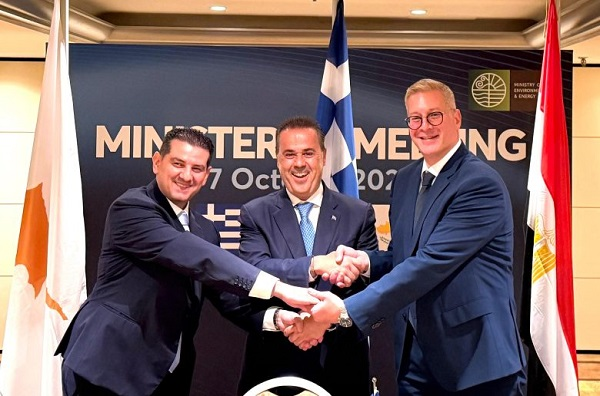
Egyptian Petroleum and Mineral Resources Minister Karim Badawi met Greek Environment and Energy Minister Stavros Papastavrou and Cypriot Energy Minister Michael Damianos in Athens during a gathering linked to the East Mediterranean Gas Forum. Their discussions centered on using the three countries’ existing assets as parts of a regional energy chain: Cypriot gas fields, Egyptian processing and liquefaction facilities, and Greek connections into European markets.
The ministers identified the development of Cyprus’s Cronos and Aphrodite fields as a priority. Under the approach discussed, gas produced offshore Cyprus could be transported to Egypt for processing and liquefaction, then shipped onward to customers. Egypt’s established gas infrastructure could shorten the route from discovery to export, while offering Cyprus and project partners a way to commercialize resources without building every stage of the export chain from scratch.
That prospect will require detailed commercial and technical agreements. The countries must determine how gas will be transported, which facilities can handle it, what capacity upgrades may be needed and how costs and revenues will be shared. The ministers called for governments and companies to address these questions and advance the most viable projects toward final investment decisions—the point at which investors commit funding and development can proceed.
Egypt’s role in the proposed network rests on its ability to receive, process and liquefy natural gas for export. Badawi argued that combining Egyptian facilities with neighboring countries’ resources could create greater value than developing each national project in isolation. For Cairo, deeper regional integration could also support its goal of becoming a hub for gas trading and exports.
Greece could help extend that network westward. Its geographic position and pipeline links offer potential routes toward southern and central European markets. The ministers discussed the Vertical Gas Corridor as part of the wider effort to connect East Mediterranean supply with European demand. The route could give gas access to a broader network of buyers and contribute to Europe’s efforts to diversify supply, though its practical role will depend on available capacity, commercial terms and the progress of infrastructure projects.
The meeting also addressed the condition of regional infrastructure. Participants considered how to make better use of existing facilities and whether additional capacity or new installations would be needed as production grows and market demand shifts. Efficient use of infrastructure is central to the proposal: new discoveries alone do not generate exports unless pipelines, processing plants, liquefaction capacity and routes to customers are available.
The ministers emphasized that predictable regulation will be important in attracting investment. Cross-border energy projects can involve multiple governments, companies and jurisdictions, making clear approval procedures and stable rules essential. They called for easier coordination, transparent arrangements for infrastructure access and efforts to resolve regulatory as well as technical and commercial obstacles.
The East Mediterranean Gas Forum is expected to help maintain that coordination. The ministers described it as a venue where member states, regulators and energy companies can track priority projects and connect resources with facilities and markets. Its role will be particularly important as the partners move from broad cooperation to decisions about specific fields, routes, contracts and investment.
The discussions build on earlier cooperation over the commercialization of Cypriot gas. Egypt and Cyprus have been working on arrangements related to Aphrodite and gas resources in Cyprus’s Block 6, which includes Cronos. The Athens meeting focused on accelerating the broader regional effort and ensuring that infrastructure and export links can support development of those resources.
The stakes are economic as well as strategic. Successful projects could generate revenue for Cyprus, create business for Egyptian infrastructure and strengthen Greece’s role as a gateway into European markets. For buyers, added routes could expand supply options. But the ministers’ meeting did not, by itself, establish a construction schedule or announce a final investment decision. Those milestones will depend on commercial negotiations and the willingness of companies to commit capital.
Badawi said the three countries have the resources, facilities and geographic links to build an integrated regional system. The challenge now is to convert those advantages into projects that meet technical and financial requirements. The ministers called for closer coordination between governments and companies, with priority given to proposals ready to move toward investment and execution.
