

Ahmed Kamel – Egypt Daily News
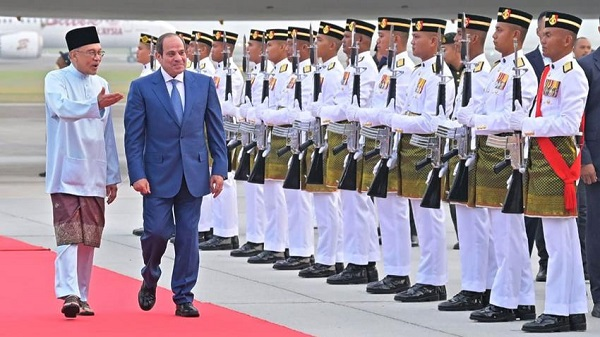
President Abdel Fattah el-Sisi arrived in Kuala Lumpur on Friday for a two-day state visit expected to bring new agreements and a review of cooperation with Malaysia. Prime Minister Anwar Ibrahim welcomed him at the airport, alongside senior Malaysian officials and Egypt’s ambassador and embassy representatives.
The visit, from October 9 to 10, was made at the invitation of Malaysia’s King, Sultan Ibrahim. It is President el-Sisi’s first state visit to Malaysia since taking office in 2014, and comes as the Egyptian leader continues an Asian tour that began in South Korea. His itinerary includes meetings with the king and the prime minister, as well as formal events hosted in his honor.
The central political engagement is a planned meeting between President el-Sisi and PM Anwar to assess progress in relations and discuss regional and international issues. The two leaders are also expected to witness the exchange of several memorandums of understanding. The documents are intended to give practical form to cooperation, although the full details and implementation plans are expected to become clearer after the meetings.
PM Anwar welcomed the Egyptian president ahead of the talks, describing the visit as an opportunity to review bilateral cooperation and exchange views on shared concerns. The Malaysian prime minister said he would attend the memorandum-exchange ceremony with President el-Sisi.
The meetings come as both governments seek to lift relations to a strategic partnership. Egypt and Malaysia established diplomatic ties in 1959, and have maintained cooperation through bilateral and international forums. A move to a strategic partnership would signal an ambition to widen those ties beyond longstanding diplomatic relations and regular official exchanges.
Trade provides a strong foundation for that effort. Malaysia’s trade with Egypt reached approximately US$720 million in 2025, making Egypt Malaysia’s seventh-largest trading partner in Africa that year. Trade continued to rise in the first eight months of 2026, reaching about US$870 million an increase of 74.7% compared with the corresponding period a year earlier.
The increase gives the leaders a concrete basis for discussing how to expand commercial links. Malaysia’s exports to Egypt have been larger than Egypt’s exports to Malaysia, leaving room for Cairo to seek more balanced trade and greater access for Egyptian goods. Stronger investment ties could also help both countries move beyond the exchange of products and toward longer-term projects involving businesses and institutions.
The visit follows President el-Sisi’s meetings in Seoul, where Egypt and South Korea elevated their relationship to a strategic partnership and announced a series of agreements across several sectors. The Malaysian leg adds another strand to Egypt’s outreach in Asia, where Cairo is seeking trade, investment and cooperation in technology and industry.
For Malaysia, closer engagement with Egypt offers a route to deepen ties with a major Arab country and a market positioned between Africa and the Middle East. For Egypt, Malaysia is a Southeast Asian partner with established manufacturing and commercial links across the region. The two sides can use the visit to identify areas where existing trade can be supplemented by investment and institutional cooperation.
The summit’s regional discussions also matter. PM Anwar said the leaders would exchange views on current regional and international developments, though officials had not publicly detailed the full agenda ahead of the talks. Their discussions are expected to reflect the countries’ interests in diplomatic coordination and stability, alongside the economic focus of the visit.
High-level visits can set priorities, but they do not by themselves guarantee new business or lasting policy changes. The value of the Kuala Lumpur meetings will depend on how quickly the memorandums are translated into specific programs, whether companies pursue new opportunities, and whether trade growth continues beyond the recent surge.
For now, the visit brings together three objectives: strengthening political ties, expanding economic cooperation and establishing a framework for future agreements. The planned strategic partnership would give the relationship a higher profile, while the memorandum exchanges could mark the first steps toward more targeted collaboration. The follow-up work in the coming months will show whether the diplomatic momentum produces measurable gains for both countries.
