
Ahmed Kamel – Egypt Daily News
Egypt has rejected the eastern-based Libyan House of Representatives’ approval of a 2019 maritime memorandum with Türkiye, saying the vote has no legal effect on Cairo and does not alter Egypt’s position on its maritime claims.
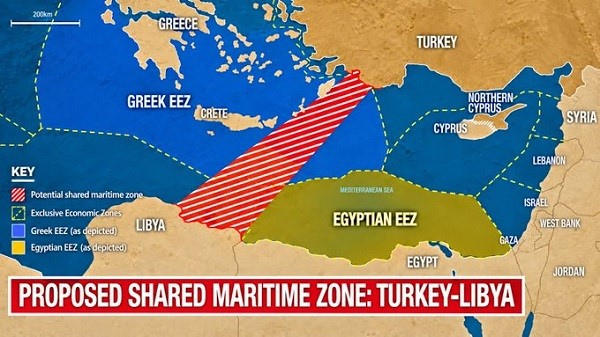
In a statement Wednesday, Egypt’s Foreign Ministry described the memorandum as “absolutely null and void” and said it violated international maritime law and provisions of the United Nations Convention on the Law of the Sea. Cairo argues that the agreement infringes on its sovereign rights in its exclusive economic zone and continental shelf. It also said it reserved the right to protect those rights under international law.
The eastern Libyan parliament approved the memorandum on Tuesday. The agreement was originally signed in 2019 by Türkiye and the Tripoli-based Government of National Accord, then Libya’s internationally recognized government. The deal sets out maritime claims in the eastern Mediterranean, a region where competing claims over sea boundaries and energy exploration rights have long strained relations among neighboring states.
Egypt has opposed the agreement since it was signed, arguing that its provisions disregard the principles used to delimit exclusive economic zones and continental shelves. The foreign ministry said the parliament’s endorsement could not change Egypt’s legal position or create legal consequences for Cairo.
The vote marks a notable shift in the eastern parliament’s stance. It had previously refused to approve the agreement and, in 2020, adopted decisions rejecting Turkish agreements and severing political ties with Ankara. The latest vote reversed that position and came amid closer engagement between Türkiye and eastern Libyan authorities.
Libya remains politically divided between rival administrations in the east and west. The eastern parliament operates separately from the authorities based in Tripoli, and the country’s political split has repeatedly complicated efforts to establish a unified national position on foreign agreements. The 2019 maritime deal was particularly contentious because Türkiye had supported the Tripoli-based government during the conflict that erupted when eastern forces advanced on the capital.
The agreement also prompted opposition from other countries in the region. Greece, which has its own disputes with Türkiye over maritime boundaries, objected to the memorandum when it was signed and criticized the Libyan parliament’s approval. Israel also condemned the vote on Wednesday, saying it infringed on the sovereign rights of its regional allies and accusing Türkiye of seeking to destabilize the eastern Mediterranean.
Türkiye defended the agreement. Foreign Minister Hakan Fidan said the deal was legitimate and characterized the Libyan parliament’s ratification as a formality, arguing that the memorandum was already in effect for Ankara. The differing responses underline the extent to which the agreement has become a point of contention over maritime jurisdiction, energy exploration and regional influence.
The European Union, meanwhile, called for respect for sovereign rights and international law. Its foreign policy chief, Kaja Kallas, said the EU had a strategic interest in a stable and secure eastern Mediterranean and urged countries to act in accordance with international law, including the UN Convention on the Law of the Sea.
That convention provides a framework for maritime zones and the rights associated with them, but competing interpretations and overlapping claims can leave disputes unresolved. Countries often rely on negotiations, legal processes or bilateral arrangements to define maritime boundaries. Egypt’s statement signals that Cairo does not consider the 2019 memorandum a valid basis for determining its own maritime rights.
The dispute has an economic dimension as well as a diplomatic one. Maritime boundaries can affect access to offshore energy resources and the authority to explore or develop them. With several eastern Mediterranean states pursuing energy projects and overlapping claims, agreements between some parties can draw objections from others that believe their rights have been bypassed.
For Egypt, the key point is that the Libyan vote does not change the boundaries or rights it claims for itself. The foreign ministry said Cairo would continue to defend its position and respond to any attempt to undermine those rights. The statement did not specify what measures Egypt might take, but it reiterated that the government considers the memorandum legally invalid and views its approval as unable to bind Egypt.
The immediate disagreement is therefore likely to persist on two tracks: diplomatic protest and competing legal claims. The parliament’s vote strengthens Türkiye’s position in its relationship with eastern Libyan authorities, while Egypt, Greece and Israel have signaled that they reject the agreement’s implications. How the dispute develops will depend on whether the parties pursue further political engagement, seek legal resolution or continue to assert competing maritime claims across the eastern Mediterranean.
