

Ahmed Kamel – Egypt Daily News
Iran has drawn up plans to strike undersea communications cables in the Gulf if the United States and Israel launch another attack, two senior Iranian security officials have said. The officials offered few operational details, but one said Tehran would seek to delay repairs after any damage, potentially extending disruption to internet and communications services.
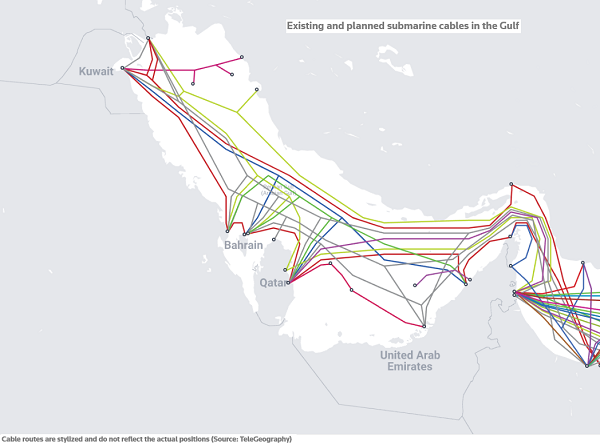
The warning adds critical digital infrastructure to the list of assets that could be threatened in a renewed conflict. Iranian officials have said that if diplomacy with Washington fails and Iran is attacked again, there would be no “red lines” on potential targets. The latest comments follow public remarks by Yadollah Javani, a deputy head of political affairs for Iran’s Revolutionary Guards, who said Iran could target seven major internet cables beneath the Strait of Hormuz if Iranian infrastructure came under attack.
The Strait of Hormuz lies between Iran and Oman, linking the Gulf with the Gulf of Oman and the Arabian Sea. Its strategic importance is most often discussed in terms of shipping and energy exports, but it is also crossed by communications cables carrying data between countries. The threats have prompted questions about how damage to those links could affect the region and whether disruption there would extend much further.
Undersea cables carry about 99% of global internet traffic, according to the International Telecommunication Union. That figure describes the worldwide importance of subsea networks, however, not the share of global traffic carried through the Strait of Hormuz. Alan Mauldin, research director at telecommunications research firm TeleGeography, said less than 1% of international bandwidth passes through the strait, suggesting that damage there alone might have a limited effect on global traffic. The consequences for Gulf countries and the users and businesses relying on those routes could still be significant.
The scale of any outage would depend on how much capacity remained available on alternative routes and whether operators could redirect data around damaged sections. Multiple cable cuts could slow internet services and disrupt financial transactions, online commerce and cloud computing, analysts said. Repairing cables during wartime would also be difficult: conflict could increase insurance costs, restrict access to territorial waters and delay the permits and arrangements required for repair vessels to operate.
Iran’s stated willingness to prevent or delay repairs adds another dimension to the threat. A damaged cable can be repaired, but a prolonged interruption could increase the economic impact on businesses and public services that rely on steady connectivity. The Iranian officials did not explain how Tehran might prevent repairs or identify any specific locations or cables that could be targeted.
The warnings also appear intended to shape the political calculations of Gulf governments and companies with major investments in the region. Alex Vatanka, director of the Iran program at the Middle East Institute, said the threats could be designed to deter renewed military action by raising concern about the risks to Gulf economies and U.S. corporate investments. One Iranian security official argued that Washington’s Gulf allies should hold the United States responsible for damage to infrastructure if conflict resumes.
That message comes as Gulf states invest in data centres, artificial intelligence and other technology industries to diversify their economies beyond oil. The region’s growing reliance on digital infrastructure has increased the potential economic stakes of a conflict. Iranian security official Mohsen Rezaei has separately warned that U.S.-linked digital infrastructure, including data centres and AI facilities, could be targeted in a renewed confrontation. During the earlier fighting, Iranian strikes hit two Amazon Web Services facilities in the United Arab Emirates and damaged infrastructure near another facility in Bahrain, according to the report..
The Red Sea may present a wider communications concern than the Strait of Hormuz. Mauldin said routes through the Red Sea carry data between Europe, East Africa and Asia, accounting for about 3% of global international demand and around 10% of traffic travelling between regions. Iran has made no public statement indicating that it plans to target cables there. The report noted that such a scenario could become more consequential if Iran had support from its Houthi allies in Yemen, but it did not describe that as an announced plan.
The United States and Iranian foreign ministries did not respond to requests for comment on the officials’ remarks, and Gulf states had not issued an immediate response. Meanwhile, governments and technology companies are developing alternative terrestrial and subsea connections to make networks more resilient. Microsoft has said it plans to invest more than $400 million in connectivity infrastructure across the Middle East by 2030.
The threats illustrate how a future conflict could extend beyond military targets and energy infrastructure to the networks that support everyday communications and commerce. But the potential impact would depend on where damage occurred, how quickly operators could reroute traffic, and whether repair crews could reach affected cables. For now, the Iranian officials’ statements signal a risk being raised as part of a broader effort to deter renewed attacks, rather than evidence that a specific operation has been launched.
