
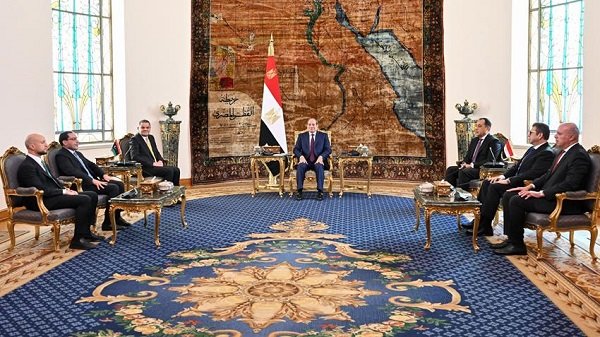
Egypt and Libya signed nine agreements and memorandums of understanding on Thursday as Egyptian President Abdel Fattah El-Sisi hosted Abdul Hamid Dbeibah, head of Libya’s Government of National Unity, for talks focused on economic cooperation, energy, reconstruction and consular issues.
The agreements cover natural gas infrastructure, petroleum refining, natural resources, fisheries and lake development, scientific research, labor, training and capacity-building, small and medium-sized enterprises, and government communications. The signing was witnessed by El-Sisi and Dbeibah at the end of their discussions, according to the Egyptian presidency.
The meeting brought together officials from both governments. Egyptian Prime Minister Mostafa Madbouly and General Intelligence Service chief Hassan Rashad attended, alongside Libyan Minister of State for Communication and Political Affairs Walid Al Lafi.
El-Sisi welcomed Dbeibah’s visit and called for stronger cooperation between the two countries, including in trade, investment, energy and reconstruction. He reiterated Egypt’s support for Libya’s security, stability and territorial integrity. Dbeibah, in turn, praised Egypt’s efforts to support stability in Libya and said his government wanted to develop cooperation across a range of fields.
The agreements provide a framework for closer cooperation, but the announcements did not specify their financial value, implementation schedules or the companies and agencies responsible for carrying out each project. Their practical impact will depend on follow-up between the two governments and the ability to translate memorandums into funded projects and working arrangements.
Travel and residency issues raised
Dbeibah raised consular concerns affecting Libyan nationals in Egypt, including visas, residency permits, the situation of Libyan students and entry through the land border. El-Sisi directed Egyptian officials to address the issues positively, and the two sides agreed that their interior ministries would coordinate to resolve them as soon as possible.
The discussions place practical travel concerns alongside the wider economic agenda. Visa and residency procedures can affect students, workers, business visitors and families who move between the neighboring countries. The Egyptian presidency did not provide details on what changes might follow or when the ministries’ coordination would produce results.
The leaders also discussed regional developments and agreed on the importance of continued coordination to support regional peace and stability and address shared challenges. The official readout did not give further detail about the specific issues discussed.
The visit comes against a complicated political backdrop. Libya remains divided between rival political and military centers, with Dbeibah’s Government of National Unity based in Tripoli and authorities and forces aligned with eastern Libya operating separately. Egypt has longstanding ties with eastern Libyan figures while also increasing engagement with the Tripoli-based government. Maintaining relationships across Libya’s divided political landscape has made Cairo’s diplomacy an important part of its approach to its western neighbor.
A further point of sensitivity is the maritime boundary dispute involving Libya and Turkey. Libya’s eastern-based House of Representatives recently approved a 2019 maritime demarcation agreement between Turkey and the former Tripoli-based Government of National Accord. Egypt has said the agreement is not binding on Cairo and challenges its maritime rights. The issue was reported to be part of the broader diplomatic context surrounding Dbeibah’s visit, although the Egyptian presidency’s meeting summary did not mention maritime boundaries as a topic of the talks.
The disagreement adds a strategic dimension to the effort to build closer economic ties. Energy cooperation, gas infrastructure and offshore resources are areas where neighboring states’ interests may overlap, making dialogue and clear arrangements important. Egypt has said it is open to discussing maritime boundaries with its neighbors, while continuing to object to the Turkey-Libya agreement.
The nine agreements announced in Cairo span both commercial and institutional cooperation. Projects involving gas and petroleum could strengthen energy links, while the fisheries, research and small-business agreements broaden the agenda beyond hydrocarbons. Training, technical support and government communications arrangements also point to an effort to deepen administrative cooperation.
For now, the most immediate commitment emerging from the meeting is a bilateral coordination process on visas, residency, student matters and border entry. The broader agreements may support closer economic relations, but their significance will depend on how quickly the two governments define responsibilities, funding and timelines. The visit underscored Egypt’s stated interest in a stable, unified Libya and in expanding cooperation with the government in Tripoli, even as regional disputes and Libya’s internal divisions continue to complicate the relationship.
