

Ahmed Kamel – Egypt Daily News
Egypt has raised the prospect of seeking financial compensation from Ethiopia for what it describes as “water-related damages” caused by the Grand Ethiopian Renaissance Dam (GERD), as diplomatic efforts to resolve the long-running dispute over the Nile project regain momentum with renewed American interest in mediation.
Cairo’s warning comes amid persistent tensions between the three Nile Basin countries most directly affected by the dam Ethiopia, Egypt, and Sudan and reflects growing frustration in Egypt over what it views as unilateral actions by Addis Ababa in the construction, filling, and operation of the massive hydroelectric facility on the Blue Nile, the Nile’s main tributary.
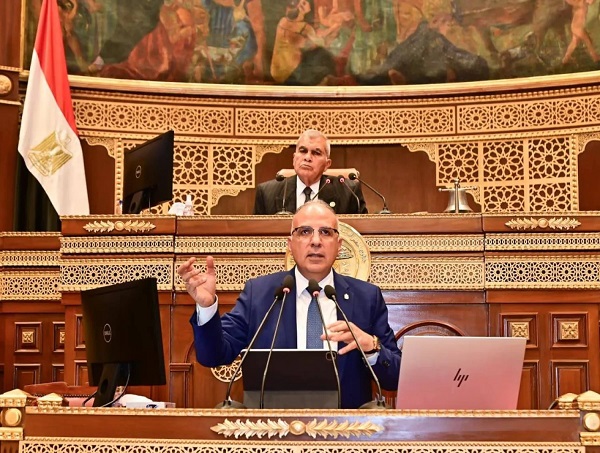
Speaking before Egypt’s Senate, Minister of Water Resources and Irrigation Hani Sewilam said that Egypt has already suffered harm as a result of the dam, even if its effects have not yet been fully felt by the public. Any reduction in Egypt’s share of Nile water, he stressed, constitutes tangible damage under international norms.
Sewilam noted that the Egyptian state has spent billions of pounds over recent years to mitigate water shortages linked to the dam, including investments in seawater desalination, wastewater recycling, and agricultural adaptation. “At some point, Ethiopia must be held accountable and compensation must be demanded for these costs,” he said, adding that Egypt and Sudan have both been affected by Ethiopia’s unilateral measures.
The GERD, whose construction began in 2011 and which Ethiopia officially inaugurated in September last year, has long been a source of regional friction. Egypt and Sudan have repeatedly called for a legally binding agreement governing the filling and operation of the dam to ensure it does not harm downstream water security. Ethiopia, by contrast, has argued that the project is essential for its development and has resisted binding constraints on its management.
Concerns have intensified in recent months following unusual fluctuations in Nile water levels. Shortly after the dam’s inauguration, severe flooding struck several Sudanese cities, while villages and agricultural lands in Egypt, particularly in the Nile Delta provinces of Beheira and Monufia, experienced an unprecedented rise in river levels, damaging farmland and homes.
Geologist and water resources expert Abbas Sharaqi of Cairo University argues that the damages caused by the GERD are both significant and scientifically verifiable. He points to Ethiopia’s storage of approximately 64 billion cubic meters of water in the dam’s reservoir, water that would otherwise have flowed to Sudan and Egypt — as well as the sudden release of water through the dam’s gates last September and October, which he says contributed to flooding downstream.
Beyond direct water losses and flood damage, Sharaqi warns of operational uncertainty. The lack of transparency regarding the dam’s management, he says, complicates the work of engineers operating dams in Egypt and Sudan, who must make critical decisions without knowing how much water will be released or when. Each billion cubic meters of water withheld from Egypt, he adds, translates into billions of pounds in agricultural losses, in addition to the high cost of alternative water sourcing.
Sharaqi maintains that such impacts can be documented through satellite imagery and hydrological monitoring data, strengthening any future legal or diplomatic case.
The renewed debate over compensation comes as Washington signals a willingness to reengage. Former U.S. President Donald Trump recently sent an official letter to Egyptian President Abdel Fattah el-Sisi expressing readiness to revive negotiations and help broker a “fair and final” solution to the dispute. El-Sisi welcomed the initiative, underscoring Egypt’s commitment to cooperation based on international law and the principles governing shared watercourses.
Sudan has also expressed support for renewed mediation. Sudanese Sovereignty Council Chairman Abdel Fattah al-Burhan said Khartoum welcomes U.S. efforts and emphasized the need for sustainable solutions that preserve the rights of all parties and contribute to regional stability.
From a legal perspective, Egyptian officials and experts argue that a compensation claim would rest on solid foundations under international law. Mohamed Mahmoud Mehran, a professor of public international law, notes that the 1997 United Nations Convention on the Law of the Non-Navigational Uses of International Watercourses obliges upstream states to avoid causing significant harm to downstream countries and to provide compensation if such harm occurs.
However, Mehran cautions that translating this principle into a successful legal claim would be procedurally complex. Any attempt by Egypt to bring a case before the International Court of Justice would require Ethiopia’s consent to the court’s jurisdiction, either explicitly or through a prior agreement, a condition that currently appears unlikely.
As diplomatic channels remain open but fragile, Egypt’s public discussion of compensation signals a shift toward raising the stakes in a dispute that has become one of the most sensitive geopolitical issues in northeast Africa. Whether this rhetoric will translate into legal action or serve as leverage in renewed negotiations remains to be seen, but it underscores Cairo’s determination to frame the GERD not only as a political challenge, but as a matter of rights, accountability, and measurable harm under international law.
