

Ahmed Kamel – Egypt Daily News
Iranian President Masoud Pezeshkian used his address to the United Nations General Assembly on Wednesday to accuse the United States and Israel of launching an unlawful war against his country and to reject Washington’s demand for negotiations conducted under military pressure.
Speaking before world leaders in New York, Pezeshkian portrayed Iran as the target of aggression rather than the instigator of the conflict. He said Iranian civilians had been subjected to “cowardly attacks” and insisted that Tehran had acted only in self-defense.
“We have only defended ourselves. We are not terrorists,” Pezeshkian said. “America and Israel attacked us.”
The speech came less than 24 hours after US President Donald Trump delivered his own address to the General Assembly, in which he threatened to “annihilate” the Islamic Republic if Tehran failed to reach an agreement with Washington. Trump presented the nearly seven-month war as necessary to prevent Iran from developing a nuclear weapon and warned that the United States could intensify its campaign.
Pezeshkian’s appearance was unusual because he addressed the UN while his country was engaged in an active war with the nation hosting the gathering. The circumstances gave the speech an atmosphere of direct confrontation, with the Iranian president responding publicly to threats made from the same international platform one day earlier.
Images of Iran’s losses
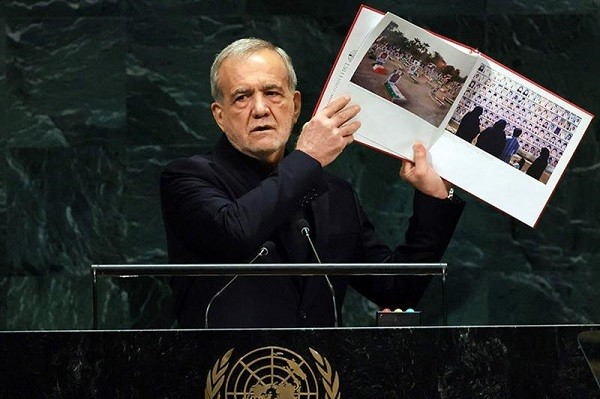
During his address, Pezeshkian displayed large photographs of Ali Khamenei, Iran’s late supreme leader, as well as images of more than 150 Iranian schoolchildren who were killed during the opening days of the conflict.
The presentation was intended to reinforce Tehran’s argument that the war has inflicted its greatest costs on civilians. Iranian officials have repeatedly accused the United States and Israel of targeting residential areas and civilian infrastructure, while Washington and its allies maintain that their military operations are aimed at Iran’s nuclear capabilities, weapons systems and senior leadership.
Pezeshkian described the attacks as a direct violation of international law and said Iran had responded with force because it had been left with no alternative.
“Yes, they did hit us, but we did not bend the knee,” he told delegates.
The Iranian leader’s language was defiant, but it also included a carefully framed offer of diplomacy. He said Tehran remained ready to negotiate, provided that discussions were not conducted through threats or coercion.
“It must be understood by Mr. Trump and those who seek to bully us that we are ready for dialogue and diplomacy and negotiations without accepting the language of force,” Pezeshkian said.
That position reflects the dilemma facing Iran’s government. Tehran wants to demonstrate that military pressure cannot force its capitulation, while also leaving open a route toward a possible ceasefire or broader agreement. The country’s economy has been severely damaged by the conflict and by restrictions on oil exports, while continued fighting has increased pressure on its population and raised fears of a wider regional confrontation.
Washington rejects Iran’s accusations
The Iranian president’s claims were quickly rejected by senior American officials. US Secretary of State Marco Rubio accused Tehran of hypocrisy and questioned its authority to lecture other countries on human rights and the international system.
Rubio pointed to Iran’s record of suppressing dissent, supporting armed groups across the region and violating international commitments. Washington has argued that the conflict began because Tehran’s nuclear activities and military partnerships posed an unacceptable threat.
Trump’s administration has also said that the war will continue until Iran agrees to strict limits on its nuclear program. Tehran insists that its nuclear activities are peaceful and denies seeking a nuclear weapon, but the issue remains at the center of the confrontation.
The competing speeches highlighted the absence of a shared factual or political framework between the two governments. Washington says it is acting to eliminate a strategic threat; Tehran says it is defending itself against an unlawful attack. Each side portrays the other as responsible for the war and presents its own military actions as unavoidable.
Diplomacy amid escalation
Despite the hostile rhetoric, American and Iranian officials held an unexpected meeting on the sidelines of the General Assembly on Tuesday. Trump said the discussions involved his envoys and Iranian representatives and described the encounter as positive, although he acknowledged that the Iranian delegation did not include the country’s highest-level officials.
The meeting suggested that diplomatic channels remain open even as public statements grow more confrontational. Earlier attempts at negotiations reportedly collapsed after a short-lived ceasefire in June, while later indirect talks involving regional mediators failed to produce a lasting agreement.
Pezeshkian’s speech may therefore serve two purposes: rallying domestic support and signaling to foreign governments that Iran is not closing the door to negotiations. By rejecting what he called the language of force while affirming Iran’s willingness to discuss an agreement, he sought to distinguish between diplomacy and surrender.
The central question now is whether the two sides can convert that limited diplomatic contact into a sustained process. Any agreement would likely have to address Iran’s nuclear activities, military capabilities, regional alliances and the future of the war. It would also need to overcome deep distrust created by months of airstrikes, threats and failed negotiations.
For the moment, Pezeshkian’s message was one of resistance. He presented Iran as wounded but unbowed, insisting that its people would continue fighting rather than accept demands imposed through force. His appearance at the United Nations demonstrated that, even amid military escalation, the conflict is also being fought through competing narratives over legality, victimhood and the meaning of self-defense.
