

Ahmed Kamel – Egypt Daily News
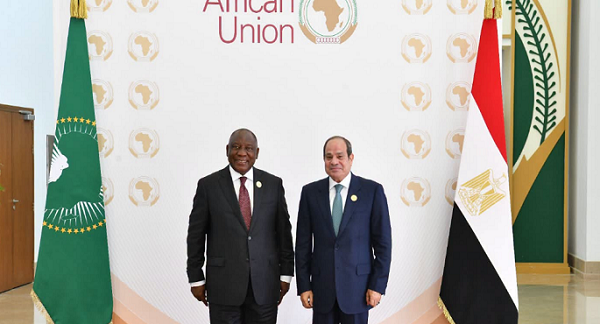
President Abdel Fattah El-Sisi met South African President Cyril Ramaphosa in New Alamein on Sunday to discuss bilateral relations, regional developments and efforts to strengthen African integration. The meeting took place on the sidelines of the eighth African Union Mid-Year Coordination Meeting, which brought together African leaders and representatives of regional economic communities and continental institutions.
The talks highlighted the growing coordination between Cairo and Pretoria as both countries seek to expand political and economic cooperation while promoting a stronger role for African-led solutions to the continent’s challenges.
During the meeting, President El-Sisi emphasized Egypt’s longstanding relationship with South Africa and expressed Cairo’s interest in broadening cooperation across political, economic, commercial and investment fields. He also stressed the importance of activating existing mechanisms for bilateral cooperation and making better use of the resources and capabilities available in both countries.
A central element of the discussions was the proposed establishment of an Egyptian-South African Business Council. The body is expected to provide a platform for private-sector representatives to explore investment opportunities, develop commercial partnerships and support trade between the two countries. Egyptian officials have presented such cooperation as part of a wider effort to promote economic integration and increase intra-African business activity.
The two countries possess large consumer markets, industrial capacity and strategic geographical positions, but bilateral trade and investment have not fully reflected their potential. A functioning business council could help address some of the obstacles facing companies, including limited information about market opportunities, regulatory differences and difficulties in establishing commercial partnerships.
President Ramaphosa welcomed Egypt’s efforts to deepen relations with South Africa and praised its role in supporting joint African initiatives. He said Pretoria was committed to strengthening coordination with Cairo, particularly on issues where the two governments share similar positions.
The South African president also commended Egypt for hosting the African Union meeting in New Alamein. The gathering focuses on the relationship between the African Union, regional economic communities and other regional mechanisms, as well as progress toward the continent’s long-term integration goals under Agenda 2063.
South Africa’s participation was particularly significant because President Ramaphosa attended in his capacity as chairperson of the Southern African Development Community. The meeting included representatives of the African Union leadership, regional blocs and development institutions, with discussions centered on improving coordination and turning continental priorities into concrete programs.
President Ramaphosa invited President El-Sisi to undertake a state visit to South Africa, a move that could provide an opportunity for further discussions on trade, investment, political coordination and continental affairs. The invitation also underlined the importance both governments attach to maintaining high-level contacts.
The Palestinian issue featured prominently in the meeting. President El-Sisi expressed Egypt’s appreciation for South Africa’s position on the Palestinian cause, while President Ramaphosa said Pretoria’s stance was influenced by Egypt’s longstanding role in supporting Palestinian rights and seeking a political settlement.
Egypt has traditionally played a central diplomatic role in efforts related to the Palestinian issue because of its geographical proximity to Gaza and its historical links with the parties involved. South Africa, meanwhile, has adopted a strongly critical position toward Israel’s policies in the occupied Palestinian territories and has repeatedly called for international action to protect Palestinian civilians and uphold international law.
The two presidents agreed on the importance of supporting efforts to establish security and stability and resolving conflicts through peaceful means. They argued that prolonged instability diverts resources away from economic development and limits African countries’ ability to improve living standards.
Their discussion also covered irregular migration, an issue that places considerable political, financial and humanitarian pressure on countries of origin, transit and destination. The leaders considered the need for coordinated responses that address both the immediate risks facing migrants and the underlying economic and security conditions that drive people to leave their homes.
Egypt and South Africa have increasingly emphasized the need for African countries to develop collective responses to challenges such as conflict, displacement, poverty and limited access to financing. Their positions reflect a broader debate within the African Union about strengthening the continent’s ability to manage its own priorities and reduce dependence on external intervention.
The meeting came as African leaders called for a shift from broad political commitments to practical projects in infrastructure, trade, financing and conflict prevention. At the wider New Alamein gathering, officials stressed that continental integration would require clearer cooperation between the African Union, regional blocs and member states, along with stronger African financial institutions.
The discussions between President El-Sisi and President Ramaphosa therefore combined immediate regional concerns with a longer-term economic agenda. While the proposed business council and the invitation for a state visit could give new momentum to bilateral relations, their impact will depend on the implementation of agreements and the ability of officials and businesses to convert political support into sustained commercial cooperation.
