

Ahmed Kamel – Egypt Daily News
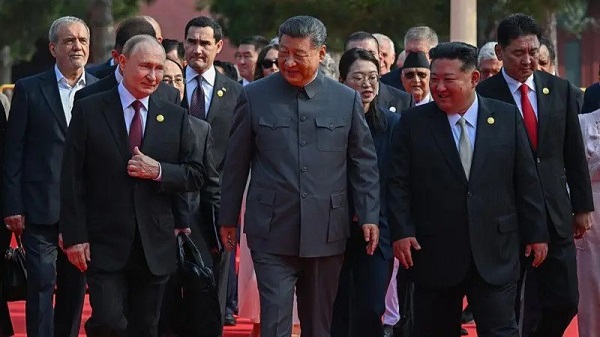
Russian President Vladimir Putin and North Korean leader Kim Jong Un held a rare bilateral meeting in the Chinese capital on the sidelines of a landmark military parade commemorating the 80th anniversary of China’s victory over Japan in World War II. The meeting marks a deepening trilateral alignment between Moscow, Pyongyang, and Beijing, amid growing global tensions and increasing estrangement from the West.
The talks took place in Beijing following Putin’s arrival in the coastal city of Tianjin earlier this week, at the invitation of Chinese President Xi Jinping. The visit, which spans several days, has been punctuated by high-level diplomatic meetings and a grand military showcase that has drawn sharp global attention.
A Historic Parade with a Geopolitical Message
The military parade, held in central Beijing, brought together for the first time the heads of state of China, Russia, and North Korea. Xi Jinping, Vladimir Putin, and Kim Jong Un in a striking display of unity. The unprecedented joint appearance on the reviewing platform sent a powerful signal to the international community, particularly the West, about the growing strategic alignment among the three nations.
Seated side by side, the three leaders watched as China unveiled an array of cutting-edge military technologies, including:
- Hypersonic ballistic missiles
- Directed-energy (laser) weapons
- Massive submersible unmanned drones
- Robotic quadrupeds for frontline reconnaissance and tactical strikes
Particularly eye-catching were dog-like robotic units, described by Chinese state media as capable of performing complex frontline operations such as delivering supplies, intelligence gathering, and executing precise attacks. The robots highlighted China’s ambition to redefine the modern battlefield with autonomous warfare systems.
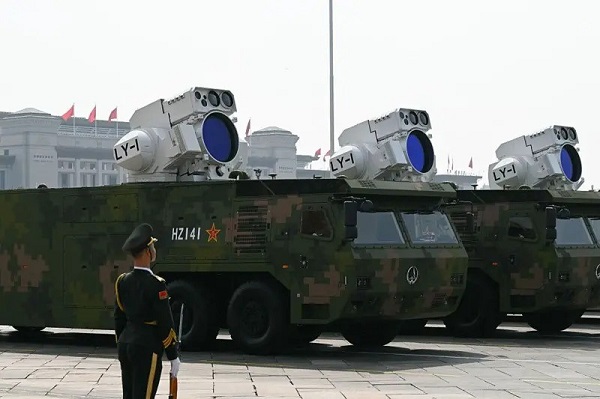
Security analysts in the West, including BBC’s security correspondent Frank Gardner, expressed concern over China’s demonstration of high-speed hypersonic missiles weapons capable of traveling at more than five times the speed of sound.
A Shift in Global Power Dynamics
During a formal luncheon following the parade, Chinese President Xi Jinping delivered a pointed speech emphasizing the importance of peace and the dangers of hegemonic power. Without naming specific countries, Xi warned against “a return to the law of the jungle, where the strong prey on the weak.”
“All nations must learn the lessons of history,” Xi said. “We must cherish peace and work together to build a brighter future for humanity.”
Only two Western-aligned leaders attended the celebrations Slovakian Prime Minister Robert Fico and Serbian President Aleksandar Vučić while Iran’s newly elected President Masoud Pezeshkian was also present.
Notably absent was any representative from the United States, whose absence along with a social media jab from former President Donald Trump underscored the deepening global divisions. “Please send my warm regards to Vladimir Putin and Kim Jong Un while you conspire against the United States,” Trump wrote online. Kremlin spokesman Yuri Ushakov dismissed the remarks as “ridiculous,” stating that no such conspiracy existed.
Putin and Kim: Brotherhood and Cooperation
On the sidelines of the parade, Putin and Kim held a separate meeting where both reaffirmed their nations’ strengthening alliance. According to North Korean state media, Kim described support for Russia as a “brotherly duty,” particularly in the context of Moscow’s ongoing war in Ukraine.
North Korea has reportedly provided military equipment and personnel in support of Russian operations a move that has drawn condemnation from Western governments and heightened concerns over illicit arms transfers.
Putin, for his part, expressed gratitude for Pyongyang’s “steadfast friendship” and reiterated Russia’s commitment to deepening cooperation in energy, infrastructure, and defense.
Challenging the US-Led Global Order
The summit in Beijing, culminating in the trio’s prominent display at the military parade, serves as a sharp counterpoint to the US-led international order. Analysts say the event illustrates a growing bloc of nations increasingly resistant to Western influence, sanctions, and military dominance.
The event also reinforces China’s effort to present itself along with Russia and North Korea as the nucleus of an alternative geopolitical framework, one that emphasizes sovereignty, non-interference, and multipolarity.
With the global order in flux, and traditional alliances under strain, the image of Xi, Putin, and Kim side by side in Beijing may well be remembered as a defining moment in the reconfiguration of 21st-century international relations.
