

Ahmed Kamel – Egypt Daily News
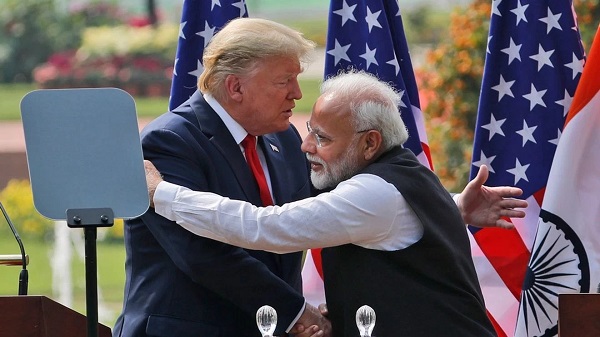
U.S. President Donald Trump announced on Monday a sharp reduction in tariffs on Indian goods following an agreement with Prime Minister Narendra Modi that includes a commitment by India to curb its purchases of Russian oil, a move with far-reaching implications for global energy markets and trade relations.
Trump said he reached the agreement after speaking with Modi earlier in the day, describing the Indian leader as “one of my greatest friends.” Under the deal, tariffs on Indian exports to the United States will be reduced to 18%, down from as high as 50%, reversing a punitive increase imposed in August aimed at pressuring New Delhi to stop buying Russian crude.
In return, Trump said India agreed to phase out imports of Russian oil and replace them with supplies from Venezuela and the United States. The president also said Modi committed to eliminating tariffs on U.S. goods, removing unspecified non-tariff barriers, and significantly expanding Indian investment in American energy, technology, agriculture and other sectors, including a $500 billion pledge covering oil, gas and coal.
A Difficult Shift Away From Russian Oil
India’s promise to reduce its reliance on Russian oil represents a major challenge. The country currently imports about 1.5 million barrels per day from Russia, according to data from global trade tracker Kpler, accounting for more than one-third of India’s total crude imports. India has continued buying Russian oil even after Western sanctions were imposed following Moscow’s invasion of Ukraine.
Analysts note that Russian crude has been particularly attractive to India because it has traded at steep discounts, around $16 per barrel compared with U.S. and OPEC oil, making it a vital input for the world’s third-largest oil consumer and a fast-growing economy with more than 1.4 billion people.
Trump said Russian oil would be replaced primarily by Venezuelan and U.S. crude. Venezuelan oil is similar in quality to Russian supplies heavy and sour making it compatible with Indian refineries, which are optimized to process such grades. However, experts caution that Venezuela’s deteriorated oil infrastructure severely limits its ability to increase output in the near term.
Venezuela once produced more than 3 million barrels per day before its oil sector fell into decline after 1999. Restoring production to that level would require years of work and tens of billions of dollars in investment. Moreover, India currently buys more oil from Russia than Venezuela produces in total.
“Fully replacing Russian oil with oil from Venezuela or the United States will take significant investment and time,” said Rob Haworth, senior investment strategy director at U.S. Bank Asset Management. While such a shift could create long-term challenges for Russia’s economy, he added, it is unlikely to happen quickly.
Skepticism Over Enforcement
Some analysts remain skeptical that India will fully abandon Russian oil. India has defended its purchases in the past as essential to national energy security, and experts say New Delhi has repeatedly found ways to navigate sanctions through intermediaries and so-called “dark fleet” shipping networks.
“There have been countless ways India has managed to outflank sanctions,” said Robert Yawger, managing director at Mizuho Securities. “They’ll find a way to keep those barrels moving.”
Others argue that changing market conditions make the transition more feasible. With global oil prices falling in recent months, the price advantage of sanctioned Russian oil has narrowed. U.S. crude was trading near $61 per barrel on Monday, down about 5%, reducing the incentive for India to rely on discounted supplies.
“When oil prices were high, the discount mattered enormously,” said Arvind Subramanian, a former chief economic adviser to India and senior fellow at the Peterson Institute for International Economics. “With prices coming down, and with Indian exporters suffering from Trump’s tariffs, it became easier politically and economically to change course.”
Markets appeared unconvinced that the agreement would significantly reshape oil flows in the near term. Oil prices showed little reaction to Trump’s announcement, with earlier declines driven instead by optimism over potential U.S.–Iran diplomacy.
Tariff Relief and Trade Stakes
Under the new arrangement, Trump said the United States would fully remove the additional 25% tariff imposed in August and reduce the broader “reciprocal” tariff rate. Because of exemptions, Indian exports had been facing an effective tariff rate of about 35%, among the highest imposed by the Trump administration.
Trump also said Modi agreed to reduce India’s tariffs on U.S. goods to zero and dismantle non-tariff barriers, which often include taxes on services, regulatory hurdles, or value-added taxes that affect foreign companies.
The agreement comes shortly after India concluded a long-awaited free trade deal with the European Union, a development that may have accelerated Washington’s push to secure preferential access for U.S. businesses.
“If India gives the EU preferential access, U.S. companies are disadvantaged,” Subramanian said. “There’s a domino effect at play.”
While India is not among America’s largest trading partners, the economic stakes are substantial. The United States imported $95.5 billion worth of goods from India in 2025 through November, about 3% of total U.S. imports, while exporting $42 billion in goods to India over the same period, according to U.S. Census Bureau data.
Top U.S. imports from India include electronics, pharmaceuticals, apparel, chemicals and jewelry prices of which have risen in part due to tariffs. Meanwhile, India’s leading imports from the United States include oil and gas, aircraft and aircraft components.
Beyond trade in goods, U.S. corporations have increasingly deepened their presence in India. Companies such as JPMorgan Chase, Microsoft, Google and American Express have expanded operations there, drawn by a large, skilled workforce and lower costs.
Whether the tariff cuts and oil pledges translate into lasting structural change remains uncertain. For now, the deal marks a significant diplomatic and economic gesture, one that signals Washington’s growing willingness to use trade policy as leverage in reshaping global energy alliances.
