

Ahmed Kamel – Egypt Daily News
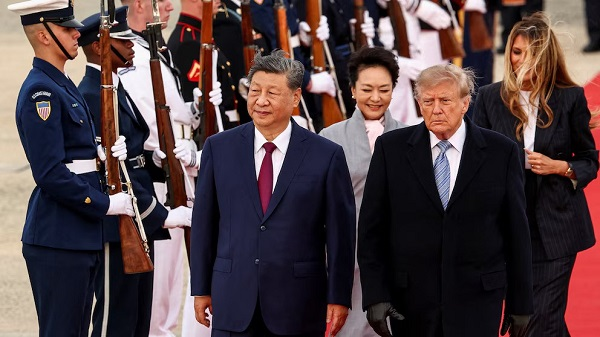
President Donald Trump personally welcomed Chinese President Xi Jinping at Joint Base Andrews on Wednesday evening, opening a closely watched three-day visit expected to test the stability of relations between Washington and Beijing.
Trump was accompanied by First Lady Melania Trump as he greeted Xi and his wife, Peng Liyuan, on the airport tarmac. The unusually formal welcome reflected the importance the White House has attached to the visit, which is expected to combine diplomatic ceremony with difficult discussions on trade, technology, Taiwan and global security.
Trump typically receives visiting leaders at the White House rather than meeting them at the airport. In Xi’s case, however, the president chose to make the arrival itself part of the diplomatic spectacle. The gesture underscored the effort to present the visit as a major summit between two of the world’s most powerful leaders, despite the long list of disputes separating their governments.
The formal program is scheduled to continue Thursday at the White House, where Trump and the first lady will welcome Xi and Peng at a ceremony on the State Floor. The two presidents are also expected to participate in a military review in the Rose Garden before beginning private talks.
The day will conclude with a state dinner in the East Room. Trump and Xi are expected to deliver remarks during the dinner, which will bring together senior officials, business leaders and some of the most influential figures in the American technology sector.
Technology leaders join the guest list
The presence of leading technology executives at the dinner is particularly significant given the growing competition between the United States and China over artificial intelligence, semiconductors and advanced computing.
Guests are expected to include Amazon founder Jeff Bezos, Tesla and SpaceX chief executive Elon Musk, Meta founder Mark Zuckerberg, Google chief executive Sundar Pichai and Dell Technologies chief executive Michael Dell.
Other invitees reportedly include Nvidia chief executive Jensen Huang, OpenAI chief executive Sam Altman, Citigroup chief executive Jane Fraser and Tim Cook, who recently stepped down as Apple’s chief executive.
Their participation gives the dinner an economic and technological dimension beyond its ceremonial role. Artificial intelligence is expected to be among the subjects discussed by Trump and Xi, particularly the question of how to prevent advanced systems from being used in ways that could threaten national security or destabilize international relations.
Washington and Beijing are competing for dominance in artificial intelligence, chip manufacturing, cloud computing and other technologies considered essential to future economic and military power. The United States has imposed restrictions on China’s access to some advanced semiconductors and manufacturing equipment, while Beijing has sought to strengthen domestic production and reduce its dependence on American suppliers.
Any discussion of AI safety could therefore be both cooperative and competitive. The two governments may explore limited agreements on safety standards, communication channels and the risks posed by autonomous systems while continuing to impose restrictions on technology transfers.
Taiwan remains a central dispute
Taiwan is expected to be another major issue during the private talks. Beijing considers Taiwan part of China and has not ruled out the use of force to bring the island under its control. Washington does not formally recognize Taiwan as an independent state but maintains close unofficial relations with Taipei and provides the island with defensive support.
The issue has repeatedly brought the United States and China into direct confrontation. Chinese military exercises around Taiwan have increased pressure on the island, while American officials have continued to emphasize the importance of peace and stability in the Taiwan Strait.
Trump’s discussions with Xi will likely focus on preventing accidental escalation. Even a temporary reduction in tensions could be viewed as a diplomatic achievement, but fundamental disagreements over Taiwan are unlikely to disappear during a single visit.
Trade and critical minerals
Trade will also be high on the agenda. The two countries have spent years imposing tariffs, export controls and investment restrictions on one another. American officials have raised concerns about market access, industrial subsidies and what they describe as unfair competition from Chinese state-supported companies.
Beijing, meanwhile, has criticized US restrictions on Chinese technology firms and argued that Washington is attempting to contain China’s economic development.
Critical minerals are another point of potential confrontation and cooperation. China occupies a dominant position in the processing of several minerals used in electric vehicles, batteries, electronics and defense systems. The United States has sought to diversify supply chains and reduce its vulnerability to possible Chinese export restrictions.
A discussion of critical minerals could produce limited agreements on supply stability, but it could also expose the strategic dependence that both sides are trying to reduce.
The war in Iran adds a security dimension
The war in Iran is expected to broaden the summit beyond the traditional US-China agenda. The conflict has created new risks for energy markets, shipping routes and regional stability, while also raising questions about Beijing’s diplomatic and economic relationship with Tehran.
China has traditionally called for negotiations and opposed the use of force as a means of resolving disputes. Washington will likely seek to understand Beijing’s position and may pressure China to use its influence to support de-escalation.
For Xi, the conflict offers an opportunity to criticize US military policy while presenting China as a potential supporter of diplomatic solutions. For Trump, it is another test of whether Beijing is prepared to cooperate on international security issues despite broader strategic rivalry.
A carefully staged final day
On Friday, Xi and Peng are scheduled to join Trump and Melania Trump for private tea and a visit to the National Archives. The tour is expected to include historical documents, adding a symbolic element to the final day of the visit before the Chinese president departs the United States.
Xi’s last state visit to the country took place in September 2015, during Barack Obama’s presidency. Trump later traveled to China for talks with Xi, continuing a relationship that has alternated between personal diplomacy and intense confrontation.
The current visit is designed to project stability, but its outcome will depend on whether the ceremony can be followed by practical agreements. The two leaders may be able to establish limited cooperation on artificial intelligence, trade or crisis communication. Yet the disputes over Taiwan, technology controls and strategic influence remain deeply rooted.
By placing Xi at the center of an elaborate state welcome, Trump has signaled that direct engagement remains essential. The challenge will be to ensure that the pageantry produces more than a temporary pause in tensions between Washington and Beijing.
