

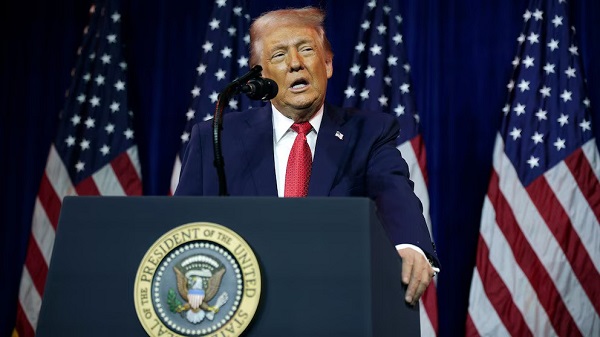
President Donald Trump said the United States would stop providing Israel with about $4 billion in annual assistance by the end of the year, describing the move as an agreement reached months ago with Israeli Prime Minister Benjamin Netanyahu. Trump made the announcement in a telephone interview with Fox News on Tuesday, Election Day.
“We’ve already agreed that by the end of this year we won’t be paying Israel,” Trump said, while adding that the United States would help Israel if it needed assistance. He argued that Israel no longer required American funding and said it could continue buying U.S. weapons.
The president did not specify which funding streams would be affected or explain how a year-end cutoff would be implemented. The current U.S.-Israel memorandum of understanding provides about $3.8 billion in annual military assistance and is scheduled to run through 2028. Trump referred to roughly $4 billion, but did not clarify whether he meant the full annual assistance package, a particular portion of it, or another arrangement.
The White House had not provided clarification, and Netanyahu’s office had not publicly commented on Trump’s announcement, according to the supplied report. The scope and timing of any change therefore remained uncertain.
Trump framed the decision partly as a response to domestic political criticism. He complained that Democrats were using U.S. aid to Israel as a campaign issue and referred to Michigan Democratic Senate nominee Abdul El-Sayed, who has criticized American support for Israel. Trump questioned why Republicans should face political attacks over the assistance when, in his view, Israel was a successful country that no longer needed it.
Netanyahu has previously said he wants to reduce Israel’s reliance on U.S. military aid. In a May interview, he said he hoped to bring the assistance down to zero over the following decade and wanted the process to begin immediately. His comments suggested a gradual transition rather than the abrupt end-of-year cutoff Trump described.
The two countries’ current aid arrangement has also been the subject of talks about what should follow it. The existing memorandum is not due to expire until 2028, and the administration has not explained how Trump’s announcement relates to those discussions. It also remains unclear whether Netanyahu agreed to end assistance on the timeline Trump named.
Aid arrangements and defense cooperation
Ending direct annual assistance would not necessarily end U.S.-Israeli defense ties. Trump said Israel could still purchase American weapons, but did not describe any new procurement or investment framework. The current assistance agreement includes funding used by Israel to buy U.S.-made defense equipment, meaning that the distinction between aid and arms purchases could be important to the implementation of any change.
Congress also has a role in funding. Although the current memorandum sets out expected annual support, Congress appropriates funding, and the administration did not detail what action lawmakers would need to take to bring about the proposed cutoff. The announcement did not identify which funds had already been approved, committed or allocated for future deliveries.
The supplied report also refers to the United States-Israel FUTURES Act of 2026 and related provisions in the proposed Fiscal Year 2027 National Defense Authorization Act. These measures concern expanded cooperation on defense technology, including research and development and possible integration of technologies. They should not be treated as a completed agreement between the two governments or as proof that a new arrangement replacing annual aid has already taken effect.
The relevant provisions are part of legislative proposals and versions of the defense authorization bill; their final status and terms are separate from Trump’s statement about ending aid.
The debate over the future of assistance comes as support for Israel has become more politically divisive in the United States. The relationship continues to have bipartisan backing, but opposition to military support has grown among Democrats, particularly following the war in Gaza that began in October 2023.
Congressional votes have reflected that tension. In July, Republican Representative Thomas Massie brought forward an amendment to cut $3.3 billion in security assistance to Israel. It received support from 103 Democrats, but was defeated by a vote of 314 to 104, with Massie the only Republican supporting it. A September Quinnipiac University poll found that 48% of voters believed the United States was too supportive of Israel, compared with 16% in 2017. The figure was higher among Democrats than Republicans.
Israel has received substantial U.S. assistance over many decades. A congressional report published last year put the total, without adjusting for inflation, at $174 billion. Any change to annual military support would therefore affect a longstanding part of the bilateral relationship, even if weapons sales and other defense cooperation continued.
For now, Trump’s statement has raised questions rather than settled them. He has described an agreement with Netanyahu and named the end of the year as the target, but has not provided its terms, identified the funding to be stopped, or explained the congressional steps required. The current aid memorandum remains scheduled to run through 2028, while the proposed technology-cooperation measures follow a separate legislative process.
