

Ahmed Kamel – Egypt Daily News
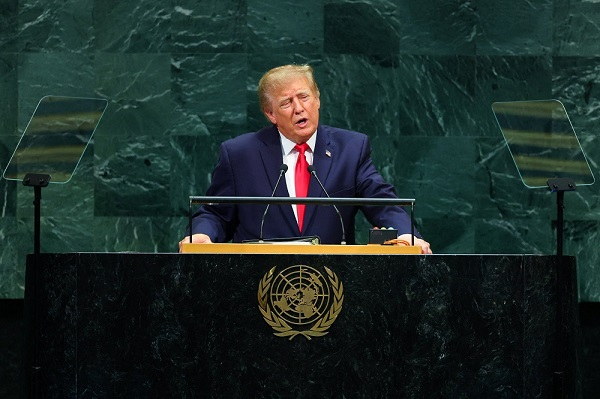
President Donald Trump used his appearance before the United Nations General Assembly to project American power, criticize international institutions and portray his administration as the force behind a series of diplomatic and military breakthroughs.
Rather than delivering a conventional appeal for cooperation, Trump presented the world body with a sharply political address focused on borders, military strength, energy policy and the conflicts in Iran, Gaza and Ukraine. He argued that the United States had regained its influence under his leadership and warned that countries unwilling to follow Washington’s approach would face growing pressure.
Trump opened by claiming that America had moved from crisis to strength during the first months of his administration. He cited the US military, the economy and border controls as evidence that the country was once again setting the international agenda.
The speech quickly turned into an attack on the United Nations. Trump questioned the organization’s effectiveness, arguing that it frequently responds to wars and humanitarian emergencies with statements rather than action. He said international institutions had failed to prevent conflicts and, in some cases, had contributed to the problems they were created to solve.
The president also delivered a direct warning to governments confronting irregular migration. He urged national leaders to strengthen their borders and accused them of allowing uncontrolled migration to undermine their societies. In one of the speech’s most confrontational lines, Trump told delegates that their countries were “going to hell” if they continued policies he associated with open borders.
Migration was closely linked in Trump’s remarks to his opposition to climate policies and the transition away from fossil fuels. He criticized government efforts to reduce emissions, describing climate initiatives as economically damaging. He also promoted expanded energy production, presenting oil and gas as essential to national independence and economic security.
Iran occupied a central position in the foreign-policy section of the speech. Trump claimed that the United States had destroyed Iran’s nuclear infrastructure during a military operation and said the action had removed the country’s ability to enrich uranium on a meaningful scale. He referred to the campaign as a demonstration of American military superiority and said no other country could have carried out an operation of comparable scale.
According to a transcript of the address, Trump linked the strikes to the end of a 12-day conflict between Iran and Israel. He said Washington had helped broker a halt to the fighting after Iran’s nuclear facilities were attacked. The claims formed the basis of Trump’s argument that military force, rather than prolonged diplomatic negotiations, had produced the most significant results.
Trump’s account was likely to face scrutiny from governments and independent analysts, particularly over the extent of damage to Iran’s nuclear program and the long-term consequences of the strikes. Even if major facilities were damaged, questions remained about whether Iran retained undisclosed capabilities, technical expertise or the ability to rebuild.
The president also spoke about Gaza, saying the United States was working to secure a cease-fire and end the war. He blamed Hamas for rejecting what he described as reasonable peace proposals and demanded the immediate release of Israeli hostages. Trump did not present a detailed framework for ending the conflict, nor did he explain how the United States would overcome the political and security obstacles preventing a lasting agreement.
His remarks came as several countries moved toward recognizing a Palestinian state. Trump criticized that decision, arguing that recognition would reward Hamas rather than encourage the group to surrender the hostages and abandon violence. He called instead for governments to send a united message demanding their release.
Ukraine was another important element of the address, although Trump devoted less attention to it than to Iran and migration. He criticized European countries for continuing to purchase Russian energy while supporting Ukraine against Russia. He also singled out China and India, accusing them of helping sustain the war by buying Russian oil.
Trump threatened additional tariffs against Russia if Moscow refused to move toward a peace agreement. However, he provided no clear timetable for imposing those penalties or specific conditions that would determine whether Russia had rejected negotiations. His comments reflected a broader strategy of pressing European allies to assume a larger share of the economic and military burden of confronting Moscow.
The address was ultimately less a traditional diplomatic speech than a declaration of Trump’s governing philosophy. He argued that military power, economic pressure, strict borders and national energy production were the foundations of stability. He portrayed the United States as willing to act alone when international organizations failed to deliver results.
Trump concluded by calling on countries to protect their borders, cultures and national interests while claiming that a more peaceful and prosperous world could emerge from stronger sovereign states. The speech offered little in the way of compromise, but it clearly communicated the administration’s priorities: confrontation with Iran, pressure on Russia, an uncompromising position on migration and deep skepticism toward the United Nations itself.
