

Ahmed Kamel – Egypt Daily News
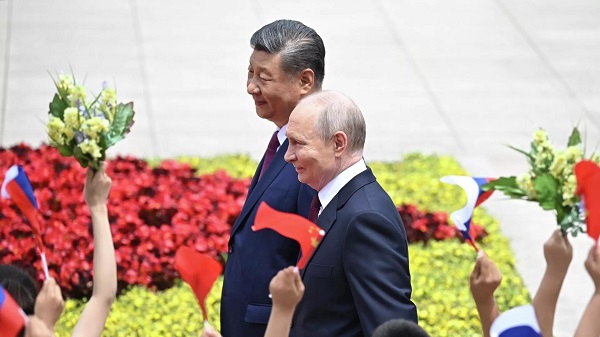
Russian President Vladimir Putin has concluded a two-day visit to Beijing, leaving with more than 40 bilateral agreements and renewed commitments to deepen economic, political and security coordination with China.
The visit included extensive talks with Chinese President Xi Jinping, focusing on trade expansion, energy cooperation and joint positions on global governance, as both countries continue to present themselves as advocates of a “multipolar world order.”
A joint statement issued at the end of the visit reaffirmed what both sides described as a strategic partnership aimed at reshaping international relations away from Western dominance, while increasing coordination inside multilateral blocs such as BRICS and the Shanghai Cooperation Organization.
Central to the talks was a further push to expand bilateral trade using national currencies rather than the US dollar. Moscow and Beijing also pledged to deepen financial cooperation mechanisms designed to shield trade flows from external sanctions pressure.
Russian officials highlighted that trade turnover is approaching $240 billion in 2025, with an increasing share of high-value industrial and technology-related goods. Chinese officials, meanwhile, said trade exceeded $200 billion despite what they called a “complex international environment,” with growth of around 20% in the early months of the year.
Energy cooperation also featured prominently in the discussions, including plans linked to long-term Russian gas supplies to China via transit routes through Mongolia, part of broader efforts to diversify China’s energy imports while redirecting Russian exports away from European markets.
Both governments emphasized continued expansion of trade settlements in rubles and yuan, a shift they say reduces exposure to external financial systems and strengthens bilateral economic resilience.
Beyond trade and energy, the two sides signed agreements covering education, scientific research and cultural exchanges, including expanded cooperation between universities in Russia and China.
Officials also reiterated a shared position opposing the deployment of weapons in space, reflecting growing alignment on security issues beyond traditional regional concerns. The visit underscored the increasingly interdependent nature of the Russia-China relationship, which has expanded sharply since 2015, with trade reportedly growing by more than 250% over the past decade.
While no detailed breakdown of all 42 agreements was released publicly, the overall outcome of the Beijing talks signals continued consolidation of ties between Moscow and Beijing at a time of sustained geopolitical tension with Western powers.
