

Ahmed Kamel – Egypt Daily News
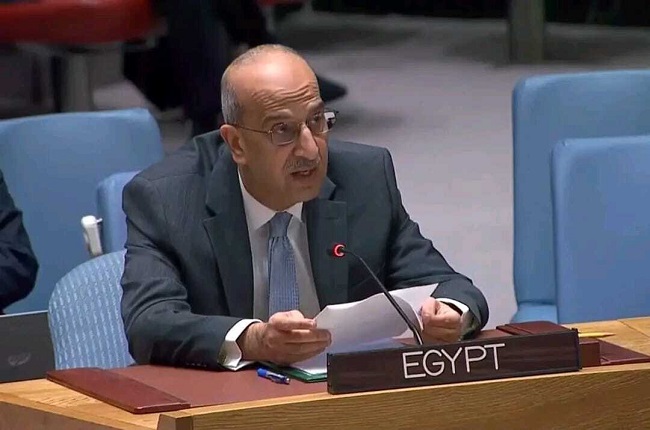
Egypt’s Permanent Representative to the United Nations, Ambassador Osama Abdel Khalek, delivered a firm statement before the UN Security Council on Monday, asserting that neither Israel nor any other power would be permitted to dominate the Middle East. His remarks came during a session dedicated to discussing the ongoing developments in the region and the escalating tensions arising from Israel’s military actions.
Ambassador Abdel Khalek, who also represents the Arab League at the UN, urged the current Israeli government described as an “extreme right-wing administration”, to abandon its “delusional dreams” of achieving what it calls the “Greater Israel” project. He warned that any attempts to impose unilateral control or expand territorial influence in the region would be met with unified Arab resistance.
“The countries of the Middle East, particularly the Arab states, will never allow Israel or any other power to dominate the region, regardless of military superiority or external support,” Abdel Khalek declared. “History has repeatedly shown that such ambitions only lead to instability and prolonged conflict.”
He emphasized that Israel’s continued military aggression against Palestine, Syria, Lebanon, and Yemen and more recently, reported strikes against Qatar serves neither its short-term nor long-term interests. Instead, he cautioned, these actions risk triggering a broader regional confrontation that would have serious consequences for peace and security.
The Egyptian envoy also denounced Israel’s ongoing policy of withholding billions of dollars in Palestinian tax revenues, describing it as a deliberate act that undermines the Palestinian Authority and fuels the rise of extremist groups as alternatives to legitimate governance. “Such measures weaken moderates, destabilize the Palestinian territories, and erode prospects for any viable political solution,” he noted.
Abdel Khalek further condemned repeated incursions by Israeli officials and extremists into Islamic and Christian holy sites, including Al-Aqsa Mosque and the Church of the Holy Sepulchre. These actions, he said, represent blatant provocations that inflame religious sensitivities, deepen hatred, and jeopardize any remaining chances for coexistence and mutual respect among the region’s communities.
The ambassador called on the international community, particularly the Security Council, to assume its responsibilities by ensuring accountability and protecting the sanctity of religious sites. He reiterated Egypt’s unwavering support for the legitimate rights of the Palestinian people and the establishment of an independent state on the 1967 borders with East Jerusalem as its capital.
Abdel Khalek’s speech reflected Egypt’s long-standing diplomatic stance that peace and stability in the Middle East cannot be achieved through force or unilateral action, but only through dialogue, justice, and adherence to international law.
