

Ahmed Kamel – Egypt Daily News
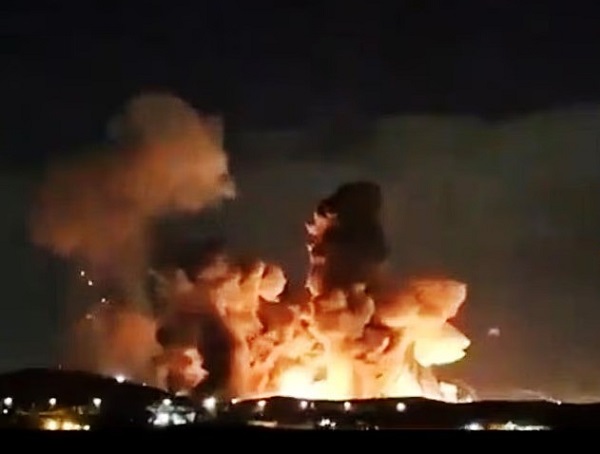
The United States launched powerful airstrikes targeting what officials described as a critical Iranian ammunition depot near the city of Isfahan. According to US officials cited by The Wall Street Journal, the attack involved heavy bunker-buster bombs designed to penetrate fortified underground facilities believed to be linked to Iran’s nuclear infrastructure. Satellite data and visual evidence suggested multiple secondary explosions, indicating the presence of stored munitions.
The strike reportedly occurred near Mount Soffeh, an area long suspected of housing military installations. While Iranian authorities have not officially confirmed the incident, the location has previously been associated with uranium-related activity and was among sites targeted during earlier phases of the Iran-Israel confrontation.
US President Donald Trump shared footage of the nighttime bombardment, though he provided no detailed explanation alongside the images. The attack follows reports that Washington had been weighing more aggressive options, including potential ground operations aimed at securing Iran’s enriched uranium stockpiles.
Almost simultaneously, maritime security concerns intensified after a large oil tanker was struck by what is believed to be an Iranian drone while anchored in Dubai. The vessel, identified as the Al Salmi and linked to the Kuwait Petroleum Corporation, was carrying approximately two million barrels of crude oil when the incident occurred.
Authorities in the United Arab Emirates confirmed that emergency teams successfully extinguished a fire onboard the tanker and reported no casualties among the 24 crew members. However, officials warned of a possible oil spill, highlighting the environmental risks associated with escalating attacks on energy infrastructure in the region.
The incident marks the latest in a growing pattern of strikes on commercial shipping in and around the Strait of Hormuz, a critical chokepoint through which roughly a fifth of the world’s oil supply passes. Since the outbreak of hostilities, multiple vessels have reportedly been targeted using drones, missiles, and naval tactics, increasing pressure on global energy markets.
Initial market reactions were swift. Oil prices surged, with Brent crude climbing above $115 per barrel in early trading before retreating amid shifting political signals from Washington. Investors remain highly sensitive to developments in the Gulf, as any prolonged disruption to shipping lanes could have significant global economic consequences.
Adding to the uncertainty, President Trump has sent mixed messages regarding the future of the conflict. While publicly threatening further strikes on Iran’s energy infrastructure including oil facilities, desalination plants, and export hubs, he has also reportedly indicated a willingness to end military operations even if the Strait of Hormuz remains closed.
Such a move would leave Iran in effective control of one of the world’s most strategic waterways, complicating future efforts to restore normal shipping operations and potentially reshaping regional power dynamics.
Meanwhile, Gulf allies including Saudi Arabia and the United Arab Emirates are said to be urging Washington to intensify its campaign. Officials from several regional states reportedly believe that the current moment presents a rare opportunity to significantly weaken Iran’s leadership and curb its regional influence.
At the same time, the conflict has expanded beyond traditional military targets. Reports indicate that Iran has launched retaliatory strikes on critical infrastructure, including water and electricity facilities in Kuwait and energy sites linked to Israel, underscoring the increasingly broad scope of the confrontation.
Despite rising market volatility, global equities have shown resilience, with several Asian markets posting gains even as oil prices fluctuate. Analysts note that investors are attempting to balance the risks of prolonged conflict against the possibility of a sudden diplomatic resolution.
As the crisis enters a new phase, the combination of direct military engagement, attacks on civilian shipping, and conflicting political signals has created a highly unpredictable environment. With no clear path to de-escalation, the Gulf remains on edge, and the stability of global energy supplies hangs in the balance.
