

Ahmed Kamel – Egypt Daily News
A gas explosion at a coal mine in northern China has killed at least 90 workers, marking the country’s deadliest mining accident in more than a decade and reigniting scrutiny over safety standards in its vast coal industry.
The blast struck the Liushenyu coal mine in Shanxi province on Friday evening while nearly 250 miners were working underground. By Saturday, state media said rescue operations were still continuing, with emergency teams combing deep sections of the mine for anyone still trapped.
Officials said 201 workers had been brought out safely, while 123 injured miners were receiving treatment in hospital. The fate of any remaining workers has not been confirmed, leaving the final toll uncertain as rescue efforts continue.
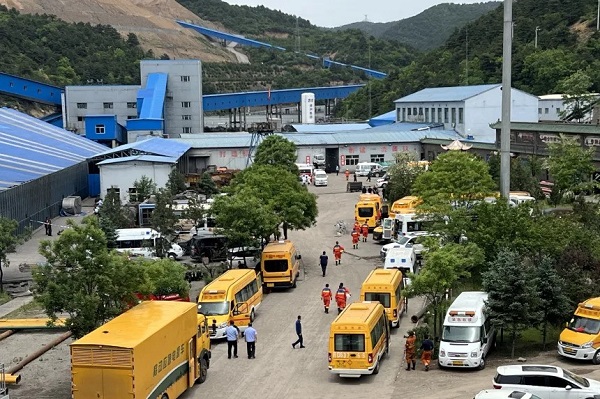
Outside the mine, ambulances lined up as hundreds of rescue personnel rotated in and out of the shafts. The operation has drawn large-scale deployment from local emergency services in Qinyuan County, part of Changzhi city, one of Shanxi’s key coal-producing areas.
Chinese President Xi Jinping ordered an “all-out rescue” and called for a full investigation into the incident, according to state media. He also urged accountability for those responsible, signaling the political sensitivity that often follows major industrial disasters in China.
Preliminary reports suggested carbon monoxide levels inside parts of the mine had exceeded safe thresholds, though authorities have not yet determined what triggered the explosion. The site remains under investigation.
One miner who survived described the moment conditions deteriorated rapidly. He recalled seeing smoke and smelling a strong sulfur-like odor just before panic spread underground. As workers attempted to escape, some were overcome before reaching safety. The survivor eventually regained consciousness and helped others find their way out.
Authorities have already moved against the company operating the mine, with state media reporting that the person in charge has been taken into custody as part of the investigation.
The incident adds to a long history of fatal mining accidents in China, where rapid industrial expansion has often outpaced safety enforcement. Although conditions have improved significantly since the early 2000s when mine disasters regularly killed more than 100 people serious incidents continue to surface.
In recent years, Beijing has tightened regulations and increased inspections, particularly after a series of deadly accidents, including a 2023 collapse in Inner Mongolia that killed 53 workers.
Coal remains central to China’s energy system, still accounting for more than half of national consumption despite a major push into renewables. That dependence has kept production high, particularly in Shanxi province, which alone produces more than a quarter of the country’s coal output.
The latest disaster is likely to prompt another round of safety inspections across the industry, but also underscores a familiar tension: China’s reliance on coal for energy security versus the recurring human cost of keeping that system running.
