

Ahmed Kamel – Egypt Daily News
Egypt News
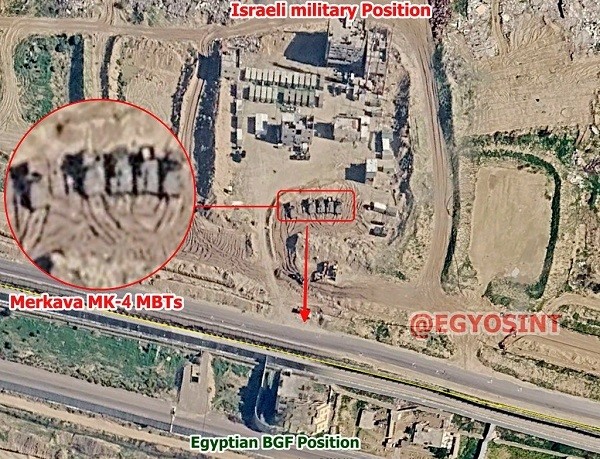
Satellite imagery circulating from southern Gaza shows Israeli armored units positioned in areas adjacent to the Rafah border with Egypt, intensifying scrutiny of military activity in one of the most sensitive corridors of the Gaza war.
The images, which appear to show Merkava tanks and artillery systems deployed inside southern Gaza, have fueled claims online that Israel is operating in violation of long-standing security arrangements governing the Egypt–Israel border region.
The positions are located near the Philadelphi Corridor, a narrow strip along the Gaza–Egypt frontier that has become a focal point of Israel’s military campaign in southern Gaza and a point of growing diplomatic sensitivity with Cairo.
Strategic corridor under military control
The Philadelphi Corridor runs along the entire border between Egypt and the Gaza Strip and has historically been a heavily restricted security zone under the framework of the 1979 Egypt–Israel peace treaty and later arrangements governing Gaza’s borders.
Following Israel’s withdrawal from Gaza in 2005, the area was placed under a complex arrangement involving Egyptian border forces and Palestinian administration, with restrictions intended to prevent heavy militarization and cross-border smuggling.
However, since the outbreak of the Gaza war, Israel has moved to assert operational control over the corridor inside Gaza, describing the area as a key route used by Hamas for weapons smuggling through tunnel networks.
The newly circulated imagery shows armored formations positioned close to the border fence separating Gaza from Egypt’s Sinai Peninsula.
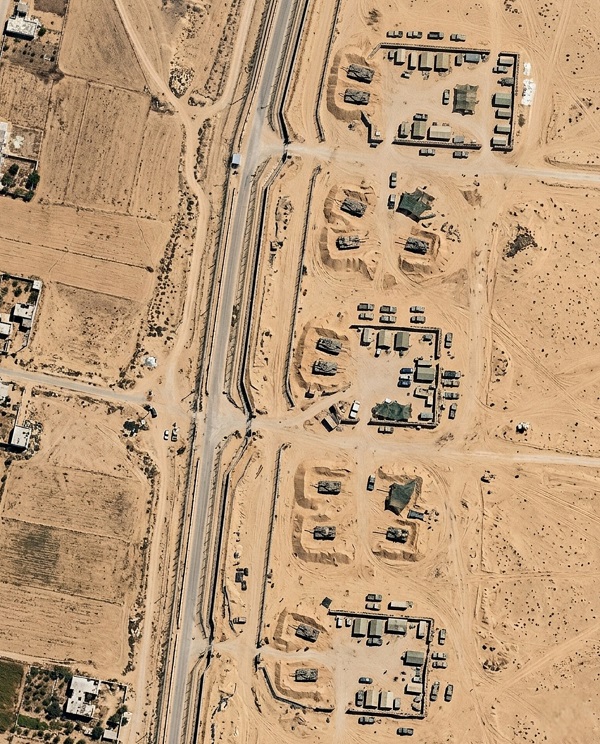
Analysts of open-source intelligence say such deployments are consistent with forward operating positions established during active combat operations in densely contested border zones.
Critics, however, argue that the presence of heavy armor and artillery so close to the border raises serious questions about adherence to the spirit of existing security understandings, particularly given the sensitivity of Egyptian sovereignty in Sinai and long-standing restrictions on militarization near the frontier.
Egypt’s security concerns
Egypt has repeatedly warned against any developments that could destabilize the Rafah border region, where fears remain high over potential displacement of Palestinians into Sinai and the spillover of fighting across the border.
Cairo has also maintained that any change to the security status of the Philadelphi Corridor must not undermine the stability of the 1979 peace framework, which remains a cornerstone of regional security.
While Egypt has not publicly confirmed any breach of treaty terms, officials have consistently described Israeli control of the corridor as a “dangerous escalation” in diplomatic communications during the war.
Israel’s position
Israel maintains that its operations in southern Gaza are aimed at dismantling Hamas infrastructure, including tunnel networks it says run beneath the Philadelphi Corridor and into Egyptian territory. Israeli officials argue that control of the border strip is essential to preventing the re-establishment of weapons supply routes and ensuring long-term security after the war.
The military has not commented specifically on the satellite images, but has previously confirmed operations in the Rafah area as part of its broader southern Gaza campaign.
A border under pressure
The Rafah frontier has become one of the most politically sensitive zones of the war, with military operations, humanitarian pressure, and regional diplomacy converging along a single narrow strip of land.
The proximity of heavy armored units to the Egyptian border continues to raise concerns in Cairo and among regional observers about the long-term stability of the post-war security order in Gaza. As fighting continues, the corridor is increasingly seen not just as a battlefield, but as a test of how far existing regional agreements can withstand the pressures of an evolving war.
