

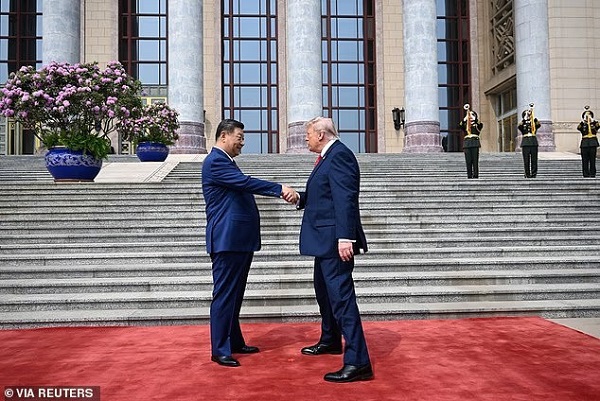
Ahmed Kamel – Egypt Daily News
The White House announced Thursday that U.S. President Donald Trump and Chinese President Xi Jinping agreed during high-level talks in Beijing that the Strait of Hormuz must remain open to safeguard global energy supplies, underscoring mounting international fears over the expanding Iran conflict and its impact on world markets.
According to the White House summary of the meeting, both leaders stressed the importance of maintaining the free flow of energy through the strategic waterway, one of the world’s most critical oil shipping routes.
“The two sides agreed on the necessity of keeping the Strait of Hormuz open to support the free flow of energy,” the statement said, signaling rare alignment between Washington and Beijing at a moment of growing geopolitical instability.
The talks took place as fears intensify over the economic fallout of the ongoing war involving Iran, which has already shaken global energy markets and raised concerns about supply disruptions that could trigger a broader international economic slowdown.
The White House also said Trump and Xi discussed expanding Chinese purchases of American agricultural products as both sides attempt to stabilize economic relations after months of uncertainty tied to tariffs, trade tensions and regional conflict.
In another notable point, a senior White House official stated that both countries agreed Iran “must never obtain a nuclear weapon,” reflecting a shared position despite broader strategic rivalry between Washington and Beijing.
Yet while the summit produced areas of apparent cooperation, deep divisions between the two superpowers quickly resurfaced over Taiwan. Although the White House’s official summary of the meeting did not mention the self-governed island, Xi reportedly delivered a direct warning to Trump earlier in the day regarding Washington’s support for Taipei.
Chinese state broadcaster CCTV quoted Xi as telling the American president that Taiwan remains “the most important issue” in U.S.-China relations and warned that mishandling the matter could push both countries toward direct confrontation.
“If it is handled incorrectly, the two countries could collide or even enter into conflict,” Xi reportedly said, warning that such a scenario would place bilateral relations in “extreme danger.”
The sharp remarks highlighted Beijing’s growing anger over continued American military support for Taiwan. China renewed its opposition this week to U.S. arms sales to the island, while uncertainty remains over a proposed $14 billion weapons package still awaiting final approval from the Trump administration.
China considers Taiwan part of its territory and has repeatedly vowed to bring the island under Beijing’s control, by force if necessary. The United States, while not officially recognizing Taiwan diplomatically, is legally obligated to provide the island with defensive capabilities under longstanding American law.
The Beijing summit unfolded against a backdrop of increasingly volatile global tensions, with both Washington and Beijing seeking to protect their economic interests while avoiding a wider geopolitical confrontation.
Despite warm public gestures and elaborate ceremony surrounding Trump’s visit, Thursday’s discussions made clear that Taiwan, trade and the Iran crisis remain powerful sources of friction between the world’s two largest economies.
