

Ahmed Kamel – Egypt Daily News
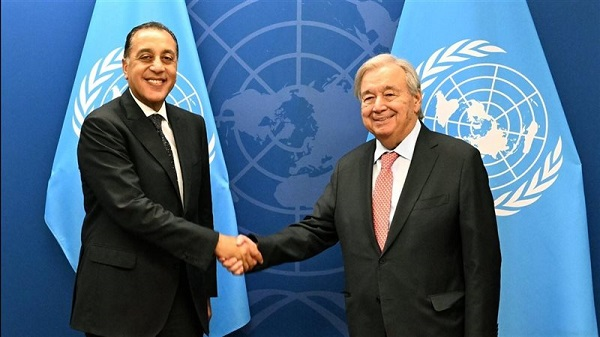
Egyptian Prime Minister Mostafa Madbouly used a meeting with United Nations Secretary-General António Guterres in New York to press for stronger international action on regional conflicts, greater support for developing countries and a more balanced global system.
The talks took place on the sidelines of the 81st session of the UN General Assembly, where Madbouly is leading Egypt’s delegation on behalf of President Abdel Fattah el-Sisi. Egypt’s foreign minister, Badr Abdelatty, and the country’s permanent representative to the United Nations, Ehab Awad, also attended the meeting.
The discussion brought together two officials who have repeatedly called for diplomacy to take precedence over military escalation. Their conversation focused on the war in Gaza, instability in Sudan, Lebanon and Yemen, the future of the international system and the need to strengthen multilateral institutions.
Madbouly began the meeting by conveying President el-Sisi’s greetings to Guterres. He praised the secretary-general’s leadership during what he described as one of the most difficult periods in recent international affairs, marked by armed conflicts, political polarization, humanitarian emergencies and growing distrust in global institutions.
The Egyptian prime minister also commended Guterres for his position on the war in Gaza. He described the UN chief’s criticism of violations of international law and Security Council resolutions as courageous and historically significant.
Guterres’s tenure has coincided with a period of intense pressure on the United Nations. The organization has faced criticism over its inability to stop wars, enforce resolutions or protect civilians in conflict zones. At the same time, the secretary-general has repeatedly warned that the international system is being weakened by geopolitical rivalry and the unwillingness of powerful states to accept common rules.
Madbouly said Egypt valued Guterres’s continued communication with Cairo and his coordination on issues considered central to Egyptian foreign policy. These include the Palestinian question, humanitarian access to Gaza, the security of neighboring states and efforts to prevent further regional escalation.
The two officials also discussed the UN80 reform initiative, which seeks to improve the organization’s efficiency and ability to respond to current global challenges. Egypt expressed support for the initiative but stressed that its implementation should remain under the ownership of member states.
That position reflects concerns among developing countries that administrative reforms could be used to reduce funding for development programs. Egypt argued that any review of the UN system must take into account the needs of poorer and middle-income countries, particularly as they face debt pressures, rising food and energy costs and limited access to financing.
Madbouly also renewed Egypt’s call for reform of international financial institutions. He said global economic bodies should become more representative and equitable, giving developing countries a stronger voice in decisions that affect their economies.
The demand has gained urgency across the developing world as governments struggle with high borrowing costs and reduced access to investment. Many countries have argued that the current financial system provides stronger protection for wealthy economies than for states facing debt crises, climate-related disasters or shortages of foreign currency.
The Palestinian issue remained the most prominent regional topic during the meeting. Madbouly reaffirmed Egypt’s support for a comprehensive settlement based on international law and established peace frameworks. He said sustainable security would not be possible without addressing the roots of the conflict, ending the occupation and creating an independent Palestinian state.
Egypt supports the establishment of a sovereign and geographically connected Palestinian state along the borders that existed before the 1967 war, with East Jerusalem as its capital. Cairo has consistently presented the two-state solution as the only framework capable of meeting Palestinian aspirations while providing a durable basis for regional peace.
Madbouly also outlined Egypt’s diplomatic efforts to help achieve Palestinian political unity. Cairo has worked with regional and international partners to bring together competing Palestinian factions and develop a common position on governance, reconstruction and negotiations.
Humanitarian assistance to Gaza was another major issue. The prime minister said Egypt would continue working to ensure that aid reaches civilians safely, consistently and without unnecessary restrictions. Egypt has acted as a principal channel for humanitarian deliveries and has hosted repeated diplomatic efforts aimed at securing cease-fires.
Guterres, for his part, praised Egypt’s role in regional diplomacy and described the country as an important pillar of security and stability. He highlighted Cairo’s efforts to address crises through negotiation rather than escalation.
The secretary-general also referred to developments in Sudan, Lebanon and Yemen. Both sides agreed that political settlements and diplomatic engagement were essential to containing these conflicts and preventing them from producing wider regional consequences.
The meeting ended with a commitment to maintain close coordination between Egypt, the United Nations and international partners. For Cairo, the discussions provided an opportunity to promote its priorities at a time when the credibility of the international system is under increasing strain. For the United Nations, cooperation with Egypt remains important because of the country’s geographic position, diplomatic influence and central role in efforts to manage Middle Eastern crises.
