

Ahmed Kamel – Egypt Daily News
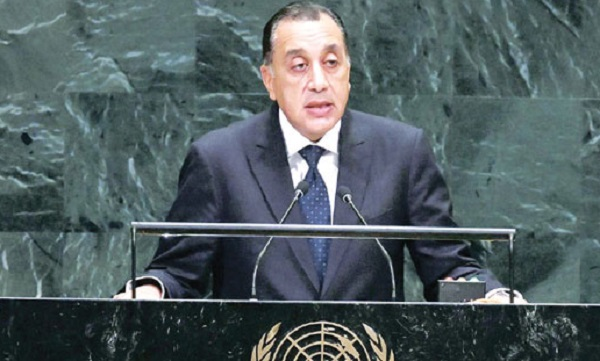
Egyptian Prime Minister Mostafa Madbouly used his address to the United Nations General Assembly to defend Cairo’s position on Palestinian displacement, the Nile River dispute and the future of the Middle East, while calling for a fairer and more effective international system.
Leading Egypt’s delegation on behalf of President Abdel Fattah el-Sisi, Madbouly said the world was facing a widening gap between the principles governments proclaim and the actions they take. He argued that international institutions were struggling to respond to rapid geopolitical, technological and economic changes, weakening public confidence in multilateral cooperation.
The theme of this year’s General Assembly “Restoring trust and managing change” was especially relevant, Madbouly said. The international community, he argued, does not merely need more meetings or declarations. It needs institutions that can produce decisions perceived as legitimate, apply international law consistently and distribute development opportunities more fairly.
Madbouly identified three principles that Egypt believes should guide efforts to rebuild trust: fairness in political representation and decision-making, equal application of international law and a more equitable distribution of the benefits of development and technological transformation.
He said Egypt was not calling for the international system to be rebuilt from the ground up. Instead, Cairo wants states to honor the original commitments of the United Nations Charter, including sovereign equality, peaceful settlement of disputes, respect for international law and cooperation in the interests of all peoples.
Gaza and the rejection of forced displacement
The Palestinian issue occupied a central place in Madbouly’s speech. He described the continuing suffering of Palestinians as the clearest example of the international system’s failure to apply its principles consistently.
He called for the consolidation of a ceasefire in Gaza, an end to daily violations, the completion of Israeli withdrawals and the guaranteed delivery of humanitarian assistance. He also supported efforts to enable a national committee responsible for administering Gaza to begin its work, followed by early recovery and reconstruction.
Madbouly presented those measures not only as humanitarian necessities but also as the foundation for a credible political process capable of addressing the origins of the conflict.
Egypt, he said, categorically rejects any attempt to remove Palestinians from their homes, whether in Gaza or in the occupied West Bank, including East Jerusalem. He warned that peace cannot be constructed by uprooting a population from its land and said any strategy that seeks regional stability while ignoring Palestinian suffering was unrealistic.
His remarks reflect Cairo’s longstanding opposition to proposals that could result in the permanent displacement of Palestinians into neighboring countries. Egypt has repeatedly argued that such a scenario would undermine the possibility of a two-state settlement, place additional pressure on regional states and create new security risks rather than resolve the conflict.
Madbouly also called on the international community to confront violations of international law and to distinguish between managing the occupation and ending it. In his view, postponing a political settlement while attempting to contain the consequences of the conflict would only prolong instability.
The Nile as an existential issue
The strongest language in Madbouly’s address concerned Egypt’s water security. He said the Nile was not simply an economic resource but the foundation of Egyptian society, agriculture and development throughout history.
“Egypt’s water security is an existential issue that allows no compromise,” he said.
The statement was directed at the continuing dispute over Ethiopia’s Grand Ethiopian Renaissance Dam, which Cairo says should be operated under a legally binding agreement involving the downstream countries, Egypt and Sudan.
Madbouly stressed that Egypt does not oppose the right of other nations to pursue development. Instead, he argued that development in one country must not cause significant harm to another. Shared water resources, he said, cannot be managed through unilateral action or a policy of creating facts on the ground.
Egypt supports cooperation, good-neighborly relations and binding agreements consistent with international law. Cairo has also maintained that any arrangement over the Nile must protect the legitimate interests of all countries sharing the basin.
The dispute has remained unresolved despite years of negotiations and repeated diplomatic efforts. Egypt and Sudan have sought guarantees covering the dam’s filling and operation, while Ethiopia has emphasized its right to use its natural resources for economic development.
Madbouly’s comments signaled that Egypt continues to prefer a negotiated settlement but considers the protection of its water supply a fundamental national security matter. He said Egypt reserved its lawful right, under the UN Charter and international law, to protect its water security and the essential interests of its people.
Regional security and national institutions
The Egyptian prime minister also argued that security in the Middle East must be treated as interconnected. No country, he said, can achieve lasting security by undermining the security of its neighbors, threatening maritime and energy routes or violating the sovereignty of other states.
He criticized regional actors that support militias, encourage separatist movements or weaken national governments in pursuit of political and economic influence. Such policies, he said, make those actors part of the problem and require a response from the wider international community.
Madbouly urged governments to support national institutions, territorial unity and political settlements shaped by the countries and regions directly affected. He also warned against turning the Middle East into a battlefield for international competition over resources and strategic influence.
In this context, he highlighted the war in Sudan. Egypt, he said, supports the Sudanese people, the country’s unity and the preservation of state institutions capable of protecting national resources. The conflict has produced severe humanitarian consequences and raised concerns about the fragmentation of Sudan’s political and administrative structures.
Cairo’s position is that a solution to the Sudanese crisis must protect civilians and preserve the country’s territorial integrity rather than deepen divisions between competing armed groups.
Disarmament and reform of global institutions
Madbouly concluded by calling for progress toward a Middle East free of nuclear weapons and other weapons of mass destruction. He warned that geopolitical and technological competition should not lead to more dangerous arms races.
Egypt supports a balanced approach to disarmament and nonproliferation, without double standards or selective enforcement. The prime minister said collective security cannot be achieved by accumulating destructive capabilities but by establishing equal rules and obligations that apply to all states.
He also supported reform of international institutions, including the Security Council, arguing that bodies created for a different era must better reflect the political and demographic realities of the present world.
For Egypt, the issues raised in Madbouly’s speech Palestinian displacement, Nile water security, the war in Sudan, regional sovereignty and disarmament are interconnected. Each reflects Cairo’s broader argument that stability cannot be built through unilateral action, military pressure or the weakening of national governments.
Madbouly’s address therefore presented Egypt as a defender of state sovereignty, negotiated solutions and international law, while warning that continued reliance on double standards could further erode confidence in the global system.
