

Ahmed Kamel – Egypt Daily News
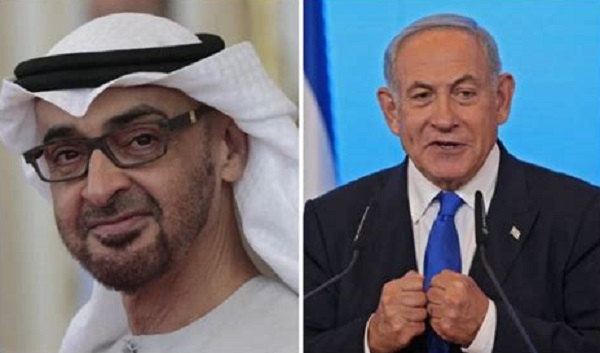
Israeli Prime Minister Benjamin Netanyahu reportedly made a private visit to Abu Dhabi on Sunday, where he met United Arab Emirates President Sheikh Mohamed bin Zayed Al Nahyan, according to Israeli media reports and people briefed on the meeting.
The visit was not announced in advance by either government. Netanyahu’s office declined to provide details, while Emirati authorities did not immediately issue a formal confirmation of the meeting. Reports said the Israeli prime minister traveled to the United Arab Emirates aboard a private aircraft, spent much of the day there and later returned to Israel.
The reported talks come at a politically sensitive moment, following claims that Sheikh Mohamed warned Netanyahu shortly before Hamas’s October 7, 2023, attack that the organization was preparing a major operation.
According to an investigation published by the Israeli newspaper Haaretz, the Emirati president allegedly spoke with Netanyahu in late September 2023 and raised concerns about Hamas leader Yahya Sinwar’s intentions. The report said the conversation lasted approximately 45 minutes and that the warning was not subsequently passed on to senior Israeli security officials.
The allegations have become part of Israel’s continuing political debate over the failures that preceded the Hamas assault. The attack breached Israel’s border with Gaza, killed Israeli civilians and soldiers and led to the abduction of hostages. Israel’s ensuing military campaign in Gaza developed into a prolonged regional conflict and remains one of the central issues in the country’s domestic politics.
Netanyahu’s office has firmly rejected the account. It has said that the prime minister did not speak with Sheikh Mohamed during the period in question and did not receive a warning from the Emirati leader. The office described the claims as completely false and has indicated that Netanyahu may pursue legal action against Haaretz and the journalists involved.
The United Arab Emirates has also offered mixed public signals. An earlier statement from its Foreign Ministry declined to confirm or deny reports about conversations between the two leaders, saying the government did not comment on speculation concerning private discussions. At the same time, the ministry stressed that Israel and the UAE maintain direct channels of communication and that relevant intelligence is shared through the appropriate institutions.
An Emirati official later gave a more pointed response, saying security matters were discussed between countries through the relevant authorities rather than at the level of national leaders. The statement was interpreted as rejecting the claim that Sheikh Mohamed personally called Netanyahu to warn him about an impending Hamas attack.
Reports about Sunday’s meeting suggested that Netanyahu asked Sheikh Mohamed to deny the alleged warning. That claim has not been officially confirmed by either government. The meeting’s reported focus could explain why the visit was kept private and why neither side immediately released a public account of the discussions.
The episode also highlights the unusual nature of the relationship between Israel and the UAE. The two countries established diplomatic relations under the 2020 Abraham Accords, a US-backed agreement that ended decades of formal non-recognition. Since then, they have expanded cooperation in trade, technology, tourism and security, even as Israel’s conflict with Hamas has placed considerable pressure on the relationship.
The UAE has criticized aspects of Israel’s conduct in Gaza while maintaining diplomatic contacts with Israeli officials. Abu Dhabi has also played a role in regional discussions concerning humanitarian assistance, hostage negotiations and postwar arrangements for Gaza.
The reported Netanyahu visit follows another disputed episode involving the two leaders. Israeli media previously reported that Netanyahu had visited the UAE earlier in the year and met Sheikh Mohamed in the city of Al Ain. Emirati authorities denied that account at the time, although a source cited by Reuters later said the leaders had met there in March.
The latest meeting therefore adds to a pattern of discreet and sometimes publicly contested contacts between Jerusalem and Abu Dhabi. It also comes amid broader regional tensions involving Iran, Israel and Gulf states. Security cooperation has become more prominent since the escalation of hostilities across the Middle East, with Israel and Arab governments facing common concerns about missile attacks, armed groups and Iran’s regional influence.
Despite the reports, no official explanation has been given for Sunday’s visit. It remains unclear whether the two leaders discussed only the disputed 2023 warning or addressed wider regional developments, including Gaza, Iran and the future of Israeli-Arab relations.
Until the Israeli or Emirati governments provide a formal account, key details including the precise timing, duration and substance of the meeting remain unverified. The alleged pre-October 7 warning is likely to remain politically significant in Israel, where questions about what Netanyahu and the security establishment knew before the attack continue to fuel demands for accountability.
