

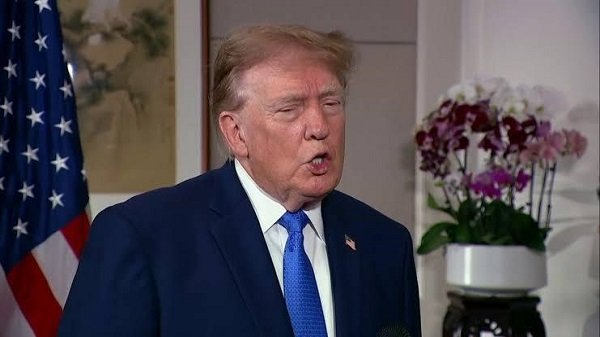
President Donald Trump said the United States would “see what happens” in its conflict with Iran after January 1, without explaining why the date could prove significant. His comments, broadcast Thursday during a visit to China, came as he was asked about reports of a possible Iranian plan involving a “dirty bomb” in Washington and amid continuing uncertainty over whether the conflict will escalate or move toward de-escalation.
“We’re going to have a new year coming up, and we’ll see what happens after January 1,” Trump told Fox News. He added that Iran had “been nasty,” but did not say whether the date marked a deadline, a change in U.S. policy, or a point by which he expected developments in the conflict.
Trump has moved between warnings of further military action and comments suggesting that hostilities could be brought to an end. His latest remarks offered no specific account of what the administration plans to do after the start of the new year, leaving the significance of the date unclear.
The interview focused in part on a CNN report that U.S. intelligence suggested Iran was developing plans for a possible attack on senior Trump administration officials in Washington using a chemical weapon or a radiological device. A so-called dirty bomb combines conventional explosives with radioactive material to disperse contamination. It is not a nuclear weapon and does not produce a nuclear explosion.
Asked whether residents of the U.S. capital should be worried, Trump replied, “I don’t think so.” He nevertheless said there were indications Iran was looking at chemical or biological weapons, without providing details or describing the evidence behind his assertion.
“There is indication that Iran is looking at gases, looking at bio, because we’ve shut them out with the nuclear,” Trump said, adding that Tehran was considering “gas and … biological weapons.” The White House had not released supporting intelligence in the statements described in the report.
The allegations have drawn differing public assessments from U.S. officials. Secretary of State Marco Rubio said Wednesday that he did not believe there was an imminent threat to Washington. He said the government remained alert to potential threats to U.S. security, but did not confirm that an attack was being planned.
Iran’s Foreign Ministry spokesperson called the CNN report “baseless” on Tuesday. Iran’s Foreign Ministry had not immediately responded to a later request for comment on Trump’s remarks. The intelligence claim, the Iranian denial and the U.S. officials’ public comments have not established that an attack is imminent.
The reported plot remains described as a potential plan rather than an attack underway. A senior U.S. official, speaking to Fox News in response to the report, said the information was not new and characterized Iran as having ambitions in this area. The CNN report, as described by other outlets, said the plans were at an early stage and represented an effort to develop options, rather than clear evidence that Tehran had decided to carry out an attack.
The distinction matters because a dirty bomb is designed primarily to spread radioactive material and create disruption, rather than produce the destructive blast of a nuclear weapon. Any such device could pose serious public-safety concerns, but the available statements do not establish that Iran has the materials, operational capability or immediate intention to carry out the reported scenario in Washington.
The dispute is unfolding against the broader U.S.-Iran confrontation. Washington and Israel have accused Iran of seeking nuclear weapons, a charge Tehran denies. Trump has cited the destruction of Iran’s nuclear program as a central justification for U.S. strikes on the country in February, conducted in coordination with Israel. The strikes and Iran’s subsequent actions have kept the possibility of renewed military exchanges in focus.
Israeli officials have also reportedly shared intelligence with Washington about what they described as Iran’s efforts to rebuild or expand military capabilities, including alleged work related to chemical weapons. The chief of Israel’s Mossad, Roman Gofman, visited the United States, and Reuters reported that he advocated resuming joint U.S.-Israeli strikes against Iran. Those claims have not been independently detailed in the public statements surrounding Trump’s interview.
Trump’s reference to January 1 adds another element of uncertainty to the administration’s public messaging. He did not link the date directly to the dirty-bomb report, specify any conditions Iran must meet, or announce a diplomatic or military timetable. For now, the clearest public assessment from a senior U.S. official is Rubio’s statement that he does not believe Washington faces an imminent threat, while Trump has said the administration is watching developments and will see what happens after the new year.
