

Ahmed Kamel – Egypt Daily News
South African jurist Navi Pillay has won the 2026 Nobel Peace Prize for her work advancing international law and accountability, placing a veteran human-rights advocate at the center of a debate over the future of global courts and legal institutions.
The Norwegian Nobel Committee said the award recognized Pillay’s efforts to promote peace through international law. Its announcement highlighted her work as a judge, human-rights official and investigator, arguing that legal mechanisms are essential to resolving conflicts and holding perpetrators of serious abuses accountable.
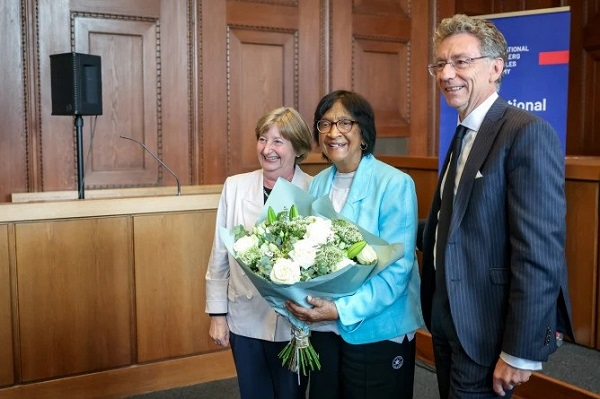
Pillay learned of the award while attending an international law gathering at the Palace of Justice in Nuremberg, Germany. The 85-year-old dedicated the prize to survivors of international crimes and to those who work to uphold justice. She also joked about sharing it with U.S. President Donald Trump, drawing laughter from the audience.
Her career spans South Africa’s apartheid era and several of the major international institutions created to address human-rights violations. Born in Durban in 1941 to a family of Indian Tamil descent, Pillay trained as a lawyer and established her own practice in 1967. She defended anti-apartheid activists before going on to become the first non-white woman appointed to South Africa’s High Court.
Pillay later served as a judge on the International Criminal Tribunal for Rwanda, including as its president. The tribunal prosecuted people responsible for the 1994 genocide. Her work there contributed to landmark legal rulings on sexual violence and the use of propaganda to incite genocide. She subsequently served as a judge at the International Criminal Court and as United Nations High Commissioner for Human Rights from 2008 to 2014.
More recently, she chaired the UN Independent International Commission of Inquiry on the Occupied Palestinian Territory from 2021 to 2025. The commission concluded that Israel had committed genocide in Gaza and accused Israeli leaders of incitement. Israel rejected the findings.
The distinction between an inquiry’s conclusions and a court judgment is important. The commission was a fact-finding body, not a court, and its report was not a binding legal ruling. The Nobel Committee said the award honored Pillay’s overall career and contribution to international law; it did not constitute a legal determination on the Gaza allegations.
The prize arrives amid sharp political disputes over international justice. Trump and Israeli Prime Minister Benjamin Netanyahu have criticized international legal institutions and rejected findings they consider politically motivated. On the day the prize was announced, the Trump administration announced new sanctions targeting the International Criminal Court, saying it aimed to restrict the court’s resources and operations. The ICC condemned the move.
That timing made Pillay’s award especially pointed, even though the Nobel Committee framed its choice around her whole career rather than a single report. The committee warned that international law and its institutions are under pressure from a growing reliance on power politics. Its message was that courts and legal processes remain necessary when governments and armed groups are accused of grave abuses.
Pillay’s work has also brought her into contact with more than one international tribunal. She is an ad hoc judge at the International Court of Justice in the case brought by The Gambia accusing Myanmar of genocide against the Rohingya. Myanmar denies the allegation. The ICJ is separate from the ICC: the former hears disputes between states, while the latter prosecutes individuals accused of crimes under its jurisdiction.
The award has drawn sharply contrasting reactions. Supporters have praised Pillay as a defender of victims and the rule of law. Israeli officials condemned the decision, accusing the Nobel Committee of legitimizing hostility toward Israel. Trump did not congratulate Pillay and shared a social-media post attacking the choice.
The disagreement reflects the broader struggle surrounding international justice: whether global courts can operate independently when powerful states dispute their authority or reject their conclusions. Pillay’s Nobel recognition elevates that question but does not resolve it. The effectiveness of international institutions still depends on cooperation, enforcement and the willingness of governments to respect legal processes.
By honoring Pillay, the Nobel Committee has placed a spotlight on a career built around the proposition that accountability can help prevent violence and support peace. Her award celebrates that principle at a moment when the institutions meant to uphold it are facing renewed political challenges.
