

Ahmed Kamel – Egypt Daily News
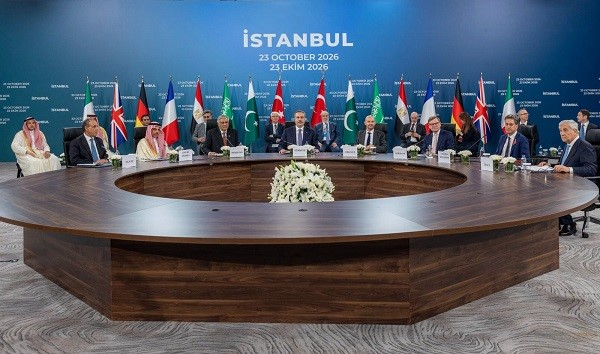
Egyptian Foreign Minister Badr Abdelatty joined counterparts from Saudi Arabia, Türkiye, Pakistan and four European countries on Friday for the first joint ministerial meeting between the regional R4 mechanism and Europe’s E4 group, as participants called for renewed diplomacy to prevent a return to military escalation in the Middle East.
The meeting brought together Saudi Foreign Minister Prince Faisal bin Farhan, Turkish Foreign Minister Hakan Fidan and Pakistan’s Deputy Prime Minister and Foreign Minister Mohammad Ishaq Dar, alongside the foreign ministers of Italy, the United Kingdom, Germany and France. The talks took place on the sidelines of broader diplomatic efforts focused on reducing regional tensions.
The R4 brings together Egypt, Saudi Arabia, Türkiye and Pakistan. The four countries have used the format for consultations on regional security and diplomacy, including discussions about de-escalation and the safety of international maritime routes. The participation of the E4 countries added a European dimension to the latest talks, with the eight governments seeking to coordinate their efforts and avert a renewed round of fighting.
Abdelatty said the meeting reflected the participants’ shared recognition of the dangers posed by renewed military escalation. He described the gathering as an opportunity for the European countries to join the R4’s work to contain tensions and argued that the group could play an active role in supporting de-escalation.
The ministers discussed ways to reduce tensions and limit the security, political and economic consequences of a wider conflict. They stressed the need to revive political and peaceful solutions, strengthen dialogue and overcome the current impasse in negotiations. A return to diplomacy, they argued, could help produce understandings capable of ending the crisis and preventing further destabilization.
The emphasis on negotiations reflects concern that renewed clashes could have consequences beyond the immediate conflict zone. Regional insecurity can disrupt trade and maritime traffic, unsettle energy and commodity markets and place additional pressure on economies already exposed to supply-chain shocks. The meeting’s participants accordingly framed de-escalation not only as a security priority, but as a matter with implications for the wider international economy.
Maritime security featured prominently in the discussions. The ministers reiterated their support for Saudi Arabia and called for attacks on international shipping to stop, while emphasizing the need to ensure full and safe freedom of navigation. Their statement underscores the importance the participating governments attach to keeping commercial sea routes open amid heightened regional tensions.
The issue carries particular significance for countries whose trade depends on secure passage through regional waterways. Disruptions can raise shipping costs and delay the delivery of goods, with effects that reach beyond the region. Earlier R4 consultations also highlighted the relationship between regional conflict, maritime routes, energy markets and global supply chains, underlining why the group has made navigation and economic stability recurring themes.
Food security was another major subject. The ministers discussed how international challenges and regional tensions are increasing pressure on food markets and supply chains. They called for closer international coordination to maintain the flow of grain and other essential food commodities and to limit the effects of crises on countries most exposed to disruptions, including Egypt and African states.
The focus on grain supplies reflects the vulnerability of import-dependent countries to shifts in global prices, transport costs and availability. Conflict and instability can affect both the movement of food and the affordability of staple goods. For governments seeking to protect household purchasing power, maintaining predictable access to essential commodities is therefore closely tied to broader efforts to secure trade routes and reduce political tensions.
By bringing the R4 and E4 together, the meeting created a wider forum for coordination among regional and European governments. The participants’ message centered on preventing escalation, restoring diplomatic momentum, supporting Saudi Arabia, protecting international shipping and safeguarding food supplies. Whether those shared priorities translate into progress will depend on the ability of the parties involved in the crisis to return to negotiations and reach practical agreements.
For Egypt, the meeting also provided an opportunity to press for a diplomatic approach that accounts for the economic consequences of instability across the region. Abdelatty’s remarks linked the need for political dialogue with the risks posed to regional security, international commerce and food supply chains concerns that, the ministers indicated, cannot be addressed in isolation from one another.
