

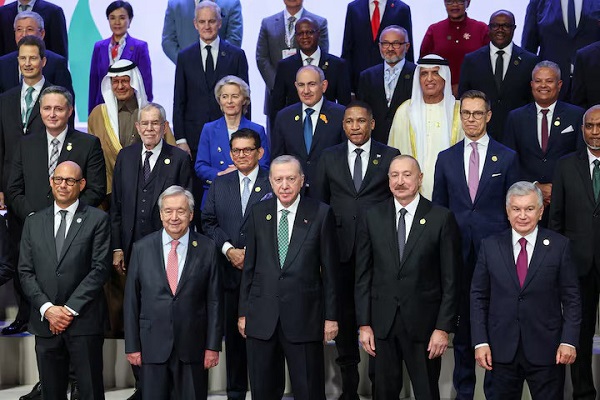
At COP31 in Türkiye, climate advocates are emphasizing a message designed to resonate beyond environmental policy: reducing reliance on fossil fuels could strengthen economies, improve energy security and ease pressure on household budgets.
The argument is being raised in speeches and discussions at the annual United Nations climate summit, where organizers are seeking to keep climate action on governments’ agendas despite competing crises. Inflation, geopolitical instability and the cost of energy have become immediate concerns for many countries, potentially making the economic consequences of fossil-fuel dependence a more persuasive case for clean-energy investment.
UN Secretary-General António Guterres told leaders that three-quarters of the world’s population live in countries that import fossil fuels. Those nations, he said, are exposed to price shocks they did not cause and cannot control. Recent conflicts, he argued, show how dependence on imported fuel can contribute to insecurity and a cost-of-living crisis. The solution, he said, is to accelerate the shift to renewable energy.
Simon Stiell, head of the UN climate office, also connected climate risks with economic pressures. Disruptions in global energy markets and climate-related disasters are adding to inflation, straining government budgets and increasing household bills, he told the conference. Climate action, he argued, can help relieve those pressures, while continued dependence on fossil fuels carries political costs.
The economic framing reflects an effort to connect long-term climate goals with problems voters and governments are confronting now. Higher energy costs can feed into prices across the economy, while fuel-price swings can make it difficult for households and businesses to plan. Advocates say renewable power can reduce exposure to some of these shocks by limiting dependence on imported fuels and volatile international markets.
Former US Secretary of State John Kerry, who has advocated for climate action for decades, welcomed the shift in emphasis. Climate change has become a deeply divisive political issue, particularly in the United States, where President Donald Trump withdrew the country from international climate cooperation last year and called global warming a hoax.
Kerry said climate advocates should change how they talk about the issue. Security, health, employment, stable communities and food supplies are all concerns people recognize, he said. Presenting climate action through those practical benefits could help bring the debate closer to everyday experience, rather than treating it only as a question of emissions and temperature targets.
The argument does not replace the scientific basis for climate policy, speakers stressed. Slovenia’s president, Nataša Pirc Musar, said governments have a responsibility to turn scientific evidence into political action and ensure decisions are guided by facts rather than short-term political interests. The economic and security case for reducing fossil-fuel dependence, in this view, complements the evidence that human-caused warming poses serious risks.
European energy commissioner Dan Jørgensen said the energy-security argument could build support even among people who doubt climate change. Countries, he said, should be able to agree that reducing dependence on fossil fuels is a smart move for security, regardless of differences over climate science.
That approach may broaden the political appeal of climate policies at a time when governments face competing demands. For some leaders, the immediate challenge is managing energy costs and protecting consumers from price shocks. For others, it is the longer-term task of cutting emissions and preparing for climate impacts. The COP31 message seeks to present these goals as connected: investing in cleaner energy can be framed both as a response to climate change and as a strategy for economic resilience.
The case will also depend on whether countries can turn broad arguments into policies and projects that deliver visible benefits. Expanding renewable energy, improving energy efficiency and strengthening infrastructure require investment and planning. Governments must weigh those costs against the potential consequences of continuing to rely heavily on fuels whose prices can be disrupted by conflict and global market shifts.
At COP31, the appeal to economic security is therefore an attempt to make climate action relevant to a wider set of political priorities. The summit’s advocates are arguing that clean energy is not only an environmental choice, but also a way to reduce vulnerability to fuel-price volatility, support household stability and protect national economies. Their challenge is to translate that message into commitments that address both immediate economic concerns and the longer-term risks of a warming climate.
