
Ahmed Kamel – Egypt Daily News
Egypt has renewed its objection to the 2019 maritime memorandum between Turkey and Libya. Foreign Minister Badr Abdelatty told his Turkish counterpart, Hakan Fidan, that Cairo considers the agreement legally invalid and says it cannot affect Egypt’s maritime rights.
The comments came during talks in Istanbul on Friday. Abdelatty described the memorandum, signed by Turkey and the government then led by Fayez al-Sarraj, as “absolutely null and void.” Egyptian Foreign Ministry spokesman Nader Zaki called it “ink on paper,” saying that its approval by Libya’s House of Representatives could not create legal consequences for Egypt.
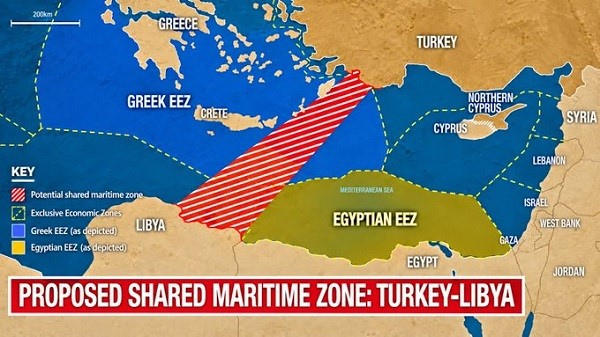
The dispute has returned to the forefront after Libya’s eastern-based parliament approved the 2019 memorandum, reversing its earlier opposition. Egypt said it rejects both the agreement and any actions based on it that conflict with Egypt’s declared maritime boundaries.
Abdelatty urged respect for international maritime law and the 1982 United Nations Convention on the Law of the Sea. He said maritime boundaries including those defining exclusive economic zones and continental shelves should be determined according to principles of fairness and equity. Cairo argues that the Turkey–Libya deal violates those principles and infringes on Egypt’s sovereign rights in its exclusive economic zone and continental shelf.
An exclusive economic zone gives a coastal state specified rights over resources in waters beyond its territorial sea. A continental shelf concerns rights to seabed and subsoil resources. The legal and political stakes are significant in the eastern Mediterranean, where maritime claims intersect with energy exploration and the interests of several coastal states. The 2019 agreement has drawn objections from Egypt and Greece over its implications for competing maritime claims.
Egypt says its opposition predates the latest parliamentary vote. Abdelatty reiterated Cairo’s longstanding rejection of the memorandum and said Egypt would not accept actions based on it when they conflict with the country’s announced maritime limits. His statement did not identify any specific steps Egypt plans to take in response.
Fidan, according to the Egyptian account of the meeting, said he understood Egypt’s concerns about developments in Libya and emphasized continued consultation and coordination. He also highlighted the importance of joint efforts to support security and stability in the country. The exchange suggested that, despite the sharp disagreement over the maritime memorandum, both sides intend to keep dialogue open.
The talks formed part of wider regional consultations involving Egypt, Turkey, Saudi Arabia and Pakistan, alongside European counterparts. The maritime issue was discussed against the backdrop of Libya’s continuing political and security challenges. Egypt has framed its position on the agreement alongside its stated support for Libya’s unity, sovereignty, territorial integrity and stability.
The memorandum was signed in November 2019 by Turkey and Libya’s then-Government of National Accord, led by al-Sarraj. Its renewed backing by Libya’s eastern parliament has brought the disagreement back into focus, but has not changed Cairo’s position: Egypt says the deal cannot diminish its maritime rights and that those rights must be respected in any future arrangements.
The Egyptian government’s description of the memorandum as invalid reflects Cairo’s legal and diplomatic position; it does not, on its own, settle the wider dispute. Competing interpretations of maritime boundaries remain a matter for international law and diplomacy. The next test will be whether the latest parliamentary approval leads to practical steps or remains primarily a political signal.
