

The Presidency
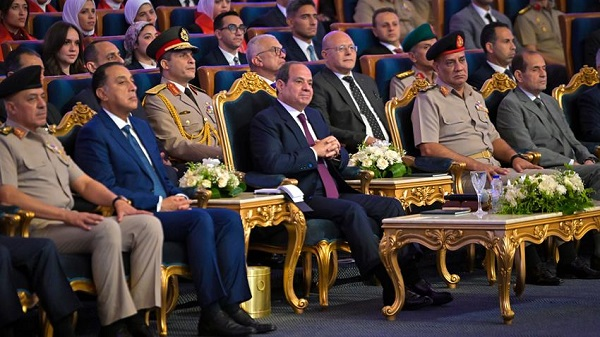
Today, President Abdel Fattah El-Sisi attended the graduation ceremony of batch (6) for judicial bodies and authorities (Ministry of Justice) from the Egyptian Military Academy, held at the Al-Safwa Hall at the Strategic Command headquarters in the New Capital.
The Spokesman for the Presidency, Ambassador Mohamed El-Shennawy, stated that upon his arrival, the President was received by Prime Minister Dr. Moustafa Madbouly, Commander-in-Chief of the Armed Forces and Minister of Defense and Military Production Lieutenant General Ashraf Salem Zaher, Chief of Staff of the Armed Forces Lieutenant General Ahmed Khalifa, Minister of Justice Counselor Mahmoud Helmy El-Sherif and Director of the Egyptian Military Academy Major General Mohamed Salah El-Turki.
The celebration included the recitation of verses from the Holy Quran. This was followed by a documentary film titled “The Beginning”, a speech by the Director of the Egyptian Military Academy, a documentary showcasing the training courses offered by the Egyptian Military Academy across various specializations, as well as the training status of batch (6) for judicial bodies and authorities and the announcement of the course results by the Assistant Director of the Egyptian Military Academy for Educational Affairs. This was followed by a speech delivered by the most senior trainee of the batch and the screening of a documentary film titled “Bridge of Justice,” and a speech by the Minister of Justice.
President El-Sisi delivered remarks, in which he congratulated the graduates, noting his keenness to be present at the graduation of 1,350 trainees.
The President added that he had previously spoken at the Academy with trainees and scholars from various disciplines and explained that, on this occasion marking the graduation of trainees from judicial bodies, it is important to discuss the concept and objective behind offering these courses at the Academy, as well as the efforts exerted over the past period. The President clarified that the Academy serves as a gateway to assuming positions in the Egyptian state. While this approach was met with initial surprise and a lack of clarity—which is normal for any new idea—the expected impact of this concept will be felt in the years to come.
The President emphasized that when he proposed that the Academy assume this role and serve as a gateway for all state institutions—whether the judiciary, the Ministry of Foreign Affairs, the Administrative Control Authority, or other bodies—the objective was to apply and implement uniform standards for everyone. The President explained that detailed criteria were established to select young men and women for each ministry according to its requirements, with the goal of creating a new entity that applies honest standards without favoritism or bias. The President stressed that if this new system is not sustained, it will lead to structural imbalances, affirming the necessity of preserving these standards and their relative weights. This is because the standards and their relative weights previously set by the state had been squandered, violated, and rendered no longer objective.
The President emphasized that if we want genuine reform of state institutions, there must be a serious path, and the time factor for its implementation is crucial. Such reform—especially in countries with millions of citizens—takes time, and everyone must realize this. The President noted that the goal is not to militarize the state, and that everyone must be aware that what happened in the period from 2011 to 2013 has not ended, that the plan did not stop and that the persistent attempts to bring down the state still exist. President El-Sisi stressed that the people and families must be aware and vigilant of this, and that responsibility in this regard rests upon everyone, not just officials, intellectuals, and media personalities.
The President added that the objective of the Academy’s courses is also to give state institutions the opportunity to coexist, and for trainees to experience multiple paths. The President affirmed that the training periods will certainly result in mutual benefit, greater cohesion, and a deeper understanding of the bonds that hold the state together.
The President pointed out that in 2011, Egypt witnessed extremely dangerous practices and faced massive problems, yet it was Allah’s will that Egypt alone should be saved. The President noted that what happened with other countries was orchestrated and planned, and that Egypt survived by the grace of Allah. This places a responsibility upon us, especially since Egypt’s resources do not permit coping with prolonged challenges.
The President affirmed that we bear the responsibility of preserving the Egyptian state rather than the person of the President or the government. The President explained that any person who imagines the issue is about preserving the President is mistaken, as this empties the matter of its substance. The President noted that among the objectives of the courses offered by the Egyptian Military Academy is to immunize youth against the idea of sabotaging Egypt, as was plotted in 2011 and 2012.
The President stressed that state institutions ought to pay attention to the graduates who have completed the courses at the Egyptian Military Academy and to follow up on them to ensure the full implementation of the concept and to prevent the recurrence of attempts to sabotage the state.
The President added that the courses at the Academy provide a substantial amount of knowledge tailored by each respective entity for its trainees, alongside another unified educational component—accounting for about 20%—delivered by the Academy and specialists to all trainees and scholars. He emphasized that all these efforts converge on the objective of human building, which is a noble mission to prepare competent, qualified individuals with balanced personalities and good values who contribute to building the state, reiterating that this is a responsibility that falls upon everyone.
The President pointed out that we must thank Allah for the blessings He bestowed upon Egypt, and that Egyptians must protect their country because any harm that befalls it will affect us all. Furthermore, the President noted that the programs offered by the Academy were developed with the participation of psychologists and sociologists, and that accepting the idea of the Egyptian Military Academy’s involvement in training cadres took time until it was accepted and these standards free from favoritism or bias were firmly established.
The President stressed the need to respect the implemented system, emphasizing that youth must be prepared scientifically and professionally, their health maintained, and continuous awareness raised among both youth and employees. The President warned against arrogance, whether through positions, jobs, religiosity, a sense of righteousness, or any other form of arrogance.
The President praised the speech delivered by the senior tainee of the course, as well as a number of those who graduated with honors, giving directives that consideration be given to selecting some of them to receive a fellowship at the National Defense College of the Egyptian Military Academy.
The President concluded his remarks by renewing his congratulations to the graduates, wishing them success, and urging them to share their understanding and knowledge with their families and friends. In this regard, the President noted the importance of making good use of social media, and stressed the need for the Ministry of Communications and Information Technology and relevant state agencies to take all necessary measures to protect children under the age of 15 from the misuse of social media platforms.
The celebration concluded with the playing of the national anthem.
