

Ahmed Kamel – Egypt Daily News
Poland was plunged into a new constitutional crisis on Friday after police deployed to the Constitutional Tribunal in Warsaw and its president, Bogdan Święczkowski, was suspended. President Karol Nawrocki turned his plane back while en route to Senegal, saying he was returning because of the situation at home. The confrontation intensified a long-running dispute between Prime Minister Donald Tusk’s government and the political right over judicial appointments and control of the court.
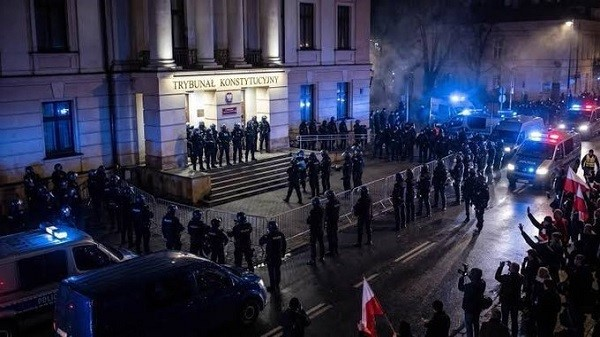
Police entered the tribunal’s premises after tensions outside the building, including incidents in which dangerous objects were reportedly thrown at officers. Authorities said police were responding to a potential public-safety threat and carrying out their duties. The deployment became a focus of competing claims: some opposition figures accused the government of using state forces to seize control of the court, while police denied that officers had interfered with the tribunal’s work.
Święczkowski’s suspension was announced by Constitutional Tribunal judge Anna Korwin-Piotrowska, who also suspended deputy president Bartłomiej Sochański for one month and assumed temporary responsibility for the institution. The move was linked to allegations that the two officials had obstructed the work of judges elected by the current parliamentary majority.
The tribunal’s leadership rejected the suspensions as unlawful, maintained that Święczkowski remained in office and described the developments as a “coup d’état.” That phrase reflects the court’s and opposition’s characterization of the dispute; it is not an established finding that a coup has taken place.
The dispute unfolded amid a wider confrontation over the tribunal’s composition and legitimacy. Earlier this year, Nawrocki refused to swear in three of six judges selected by parliament, while Święczkowski declined to allow judges elected by the current parliamentary majority to take up their duties. The standoff has left the court’s authority and operations contested.
The conflict has roots in years of disagreements over judicial appointments and reforms. During the previous government, led by the Law and Justice party, changes to Poland’s judicial system drew criticism from European institutions over judicial independence. Tusk’s government, which took office after the 2023 election, has pledged to restore the rule of law and address disputes with the European Union. Nawrocki, who is aligned with the right-wing opposition, has challenged the government’s approach and blocked some of its judicial appointments.
Tusk defended his government’s efforts to change the judicial system, saying that restoring the rule of law required decisive action. Opposition figures, including members of Law and Justice, said the police presence and the attempted suspension of the tribunal’s leadership threatened the independence of the institution. The court’s official channels also disputed the authority of Korwin-Piotrowska to take over as acting head, arguing that she had not been sworn in by the president.
Nawrocki announced that he was interrupting his journey to Senegal and returning to Poland. His planned trip included official engagements in Dakar, but his office said the developments at the tribunal required his presence in the country. The president’s decision brought the standoff between the presidency and government into sharper focus, though it did not resolve the legal dispute over who has authority to lead the court.
Members of parliament and supporters of the opposition gathered near the tribunal as police secured the area. Reports from the scene described officers restricting access to the building, while the tribunal’s leadership and opposition figures said Święczkowski and some legislators were prevented from entering. Police said their actions were related to public order and safety. The differing accounts have added to uncertainty about what took place inside and around the court.
The Constitutional Tribunal is responsible for deciding whether laws comply with Poland’s constitution. Disagreement over its membership has therefore become a wider institutional conflict, with consequences for the authority of court rulings and the balance of power among state institutions. The latest events have not produced a settled legal resolution, and the legitimacy of the suspension remains disputed.
The immediate crisis centers on the tribunal’s leadership, police access to its premises and Nawrocki’s return from Senegal. More broadly, it reflects the unresolved conflict over judicial appointments that has divided Poland’s government, presidency and opposition for years. Officials and political leaders have offered sharply different accounts of the legality and purpose of the latest actions, leaving the country facing another test of its constitutional institutions.
