

Ahmed Kamel – Egypt Daily News
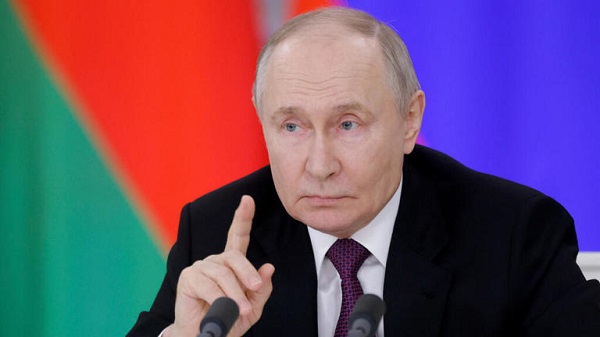
Russian President Vladimir Putin said Moscow was prepared for a conflict if tensions with Europe continued to rise, while also insisting that Russia did not want a war and warning that a confrontation would have no winners. He made the remarks at a press conference in Moscow following the Russia-Africa summit, responding to discussion in Europe about preparations for a possible conflict by 2030.
“First of all, we are ready, but we don’t want any war with Europe,” Putin said. He added that countries seeking a confrontation should prepare for one, and warned: “If things go too far, there will be no winners at all.” He also said he believed efforts to inflict a strategic defeat on Russia had not succeeded and were unlikely to do so by 2030.
The comments come amid concern among European governments and military officials about Russian activity described as hybrid operations. Such activity can include cyberattacks, sabotage and other actions intended to disrupt critical infrastructure or test security without crossing the threshold of open military conflict. European officials have warned that these incidents could increase pressure on NATO members and raise the risk of a miscalculation.
A Western intelligence official quoted in the report said Russia had a clear appetite for “sub-threshold or hybrid operations” against NATO countries, including sabotage and cyber activity. The official also said Putin wanted to avoid a direct confrontation with NATO, but warned that the risk of miscalculation remained. That concern is that an operation intended to remain limited could provoke a response or escalate beyond what either side intended.
Several recent incidents have contributed to European concerns. Germany’s military reportedly raised its threat assessment to its second-highest level earlier this month, citing what it described as a significant risk of Russian sabotage. In Britain, authorities have investigated arson attacks on properties linked to former prime minister Keir Starmer, which Moscow is believed to have been behind, according to the account. The report also cited drone activity near British military sites and over European airspace as part of the broader security picture.
Those claims have intensified debate about the form and purpose of Russia’s actions. European military leaders are concerned that drone flights, cyber activity and suspected sabotage could be used to probe defenses and pressure countries supporting Ukraine. Intelligence officials, however, have reportedly dismissed fears that Russia is prepared to use nuclear weapons against Europe, while warning that a sustained sabotage campaign could still lead to an unintended confrontation.
Putin said he supported steps aimed at restoring relations between Russia and European countries. He also said Moscow did not want the Baltic Sea to face a situation like the Strait of Hormuz, which he described as being held “ransom” by Iran following joint US-Israeli strikes. His remarks combined a warning about the consequences of escalation with an expression of support for renewed diplomatic engagement.
The diplomatic discussion has recently included a phone call between the leaders of Norway and Finland and Putin. The conversation, described as “frank and substantive,” lasted about 90 minutes and was reported as the first call between pro-Ukraine European leaders and the Russian president in more than a year. Its timing drew criticism from other Nordic leaders, who said they had not been informed beforehand.
Danish Prime Minister Mette Frederiksen said the call had not been coordinated with the rest of the group. She urged European leaders to be cautious about giving Putin an opportunity he had not previously had, emphasizing the importance of maintaining a unified position. Swedish Prime Minister Ulf Kristersson also said he had received no advance notice and expressed limited expectations for the conversation.
Finland’s president, Alexander Stubb, and Norway’s prime minister, Jonas Gahr Store, defended the outreach in a joint statement, saying direct discussions were necessary to end the war. Store said the leaders had stressed the importance of de-escalation while acknowledging substantial differences in their positions.
Ukrainian President Volodymyr Zelensky spoke with the Nordic leaders after their call with Putin. He said they had made clear to the Russian president that genuine steps to reduce tensions were needed, particularly concerning Ukraine’s energy infrastructure. The exchanges highlight the challenge facing European governments: maintaining pressure and unity in support of Ukraine while considering whether direct communication with Moscow can help reduce the risk of further escalation.
Putin’s remarks did not announce a new military step, but his warning that Russia was “ready” if tensions went too far added to the increasingly sharp rhetoric between Moscow and Western governments. His statement that there would be no winners in a war with Europe was paired with a call for restored relations, leaving diplomacy and deterrence competing at the center of the current debate.
