

Ahmed Kamel – Egypt Daily News
The latest exchange between the United States and Iran has shifted the focus of the conflict from military installations to the commercial vessels that keep Tehran’s economy functioning.
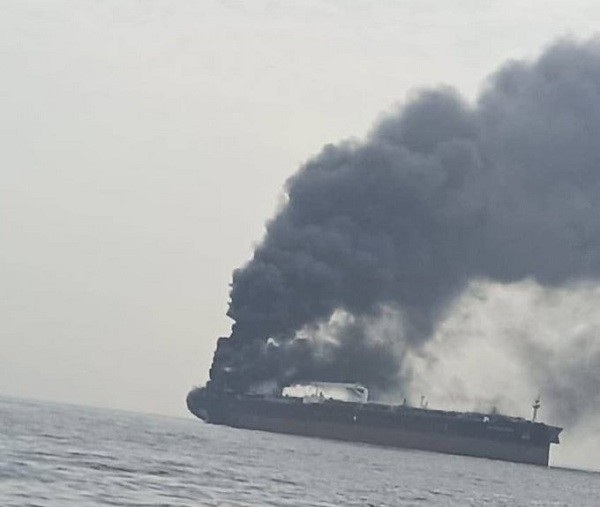
U.S. forces attacked three Iranian oil tankers on Saturday after Washington said Iran had launched ballistic missiles at two American Navy ships operating in regional waters. The strikes represent one of the clearest examples yet of the growing overlap between the war at sea and the campaign to weaken Iran economically.
According to U.S. Central Command, an American aircraft carrier and a guided-missile destroyer avoided several attacks attributed to Iran’s Islamic Revolutionary Guard Corps. No U.S. service members were reported injured. American forces then targeted three Iranian-registered vessels: two crude carriers were disabled, while a third ship, which was empty, was struck repeatedly and rendered unusable.
The vessels were identified by Central Command as the M/T Downy, hit near Kharg Island; the M/T Stark 1, targeted near Jask; and the M/T Kylo, attacked in the Gulf of Oman. The crew of the Kylo was ordered to leave before the vessel was hit in several critical areas. Iranian media also reported that crews had evacuated ships near the location of the attacks.
Washington says the tankers were not ordinary commercial targets. U.S. officials describe them as components of a large clandestine shipping and financial network that helps Iran move oil despite sanctions. The network, they argue, provides money to the Revolutionary Guard and to armed groups aligned with Tehran across the Middle East.
Adm. Brad Cooper, who commands U.S. Central Command, presented the operation as a direct response to Iran’s attack on American naval vessels. He warned that the United States would continue to defend its forces and could destroy more of Iran’s exposed oil fleet if further attacks took place.
The Iranian government gave a sharply different account. Its Foreign Ministry called the American action unlawful and accused Washington of combining military aggression with a naval blockade and economic warfare. Iranian officials said the strikes violated international law and warned that further attacks on Iranian shipping could produce a stronger response against U.S. forces.
The immediate danger extends beyond the ships themselves. Kharg Island, located in the Persian Gulf, is the main outlet for Iran’s oil exports and therefore a crucial source of revenue for the government. Iranian state media said an American missile attack struck a tanker near the island, approximately six miles from the coast. The area has already been repeatedly drawn into the conflict, including during U.S. attacks on military positions there earlier this year.
Kharg’s importance makes any fighting in its vicinity especially sensitive. Damage to storage facilities, loading infrastructure or nearby shipping could reduce Iran’s ability to export oil even without a direct attack on the terminal. It could also prompt insurers and shipping companies to avoid the region, further reducing maritime traffic.
The tanker operation followed a renewed round of violence after a period of relative quiet. The broader confrontation began on Feb. 28 with American and Israeli attacks on Iran and has since alternated between airstrikes, attacks on ships, sanctions and unsuccessful diplomatic initiatives. President Donald Trump appeared to play down the conflict a day before the tanker strikes, referring to it as “small potatoes,” even as military operations resumed around the Gulf.
The human cost has also grown. At least five people were killed earlier in the week during an American bombardment in southern Iran, according to the supplied reporting. One strike hit near a wedding gathering and wounded teenagers who had been on their way to the celebration.
While the United States has used military force to protect ships and punish attacks, the administration has also pursued financial pressure. American officials have targeted institutions accused of processing Iranian funds and have sought to disrupt the channels used to sell and transport sanctioned oil.
That strategy faces a determined opponent. Iran has spent decades developing methods to bypass sanctions, including the use of aging tankers, complex ownership arrangements and ship-to-ship transfers. The shadow fleet allows Tehran to keep oil moving even when individual vessels are identified and sanctioned.
Diplomacy has deteriorated at the same time. Talks concerning Iran’s nuclear program broke down after Washington and Tehran signed a memorandum of understanding in June. Britain, France, Germany and the United States are now considering whether to refer Iran to the United Nations Security Council over alleged failures to meet its nuclear obligations.
Iran’s main source of leverage is the Strait of Hormuz, one of the world’s most important energy routes. The waterway carries oil and natural gas shipments between the Persian Gulf and international markets. Since the war intensified, commercial traffic has declined, and American forces have helped guide some vessels through the passage.
The tanker strikes increase the risk that the strait will become even more dangerous. If Iran retaliates against U.S. ships or commercial vessels, and Washington responds with additional attacks on Iranian shipping, a cycle of escalation could disrupt energy supplies far beyond the region. For now, both governments are signaling that they are prepared to impose greater costs on the other, while negotiations remain stalled.
