

Ahmed Kamel – Egypt Daily News
U.S. President Donald Trump claimed Monday that he suspended a planned American military strike against Iran after urgent appeals from Gulf leaders seeking to give diplomacy another chance amid ongoing negotiations to end months of devastating regional conflict.
In a dramatic statement posted on Truth Social, Trump said he had been personally asked by Tamim bin Hamad Al Thani, Mohammed bin Salman, and Mohamed bin Zayed Al Nahyan to postpone what he described as a scheduled military attack against the Islamic Republic that had been planned for Tuesday.
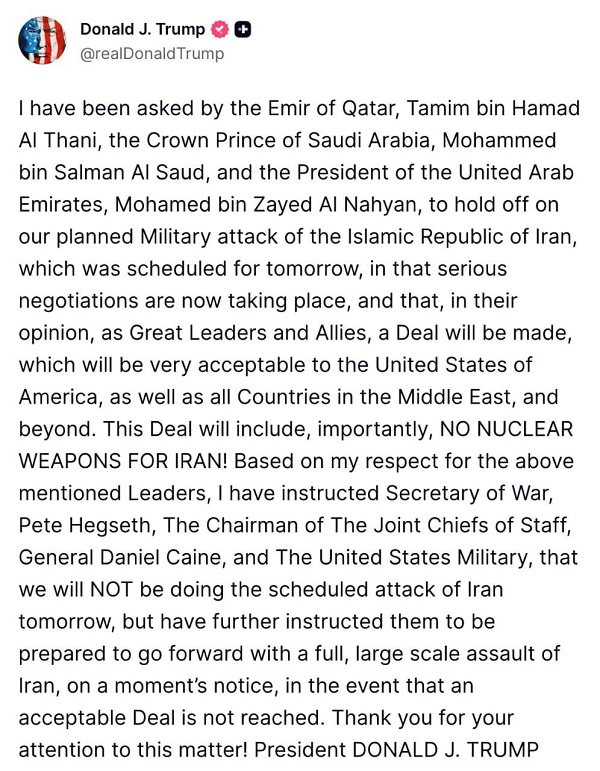
“I have been asked… to hold off on our planned military attack of the Islamic Republic of Iran,” Trump wrote, claiming Gulf leaders believed “serious negotiations are now taking place” and that a deal acceptable to the United States and the broader Middle East could still be reached.
Trump added that he had instructed Defense Secretary Pete Hegseth, Chairman of the Joint Chiefs of Staff Daniel Caine, and the U.S. military to suspend the planned strike.
At the same time, the American president warned that U.S. forces remained ready to launch “a full, large scale assault” on short notice if negotiations collapsed.
The announcement marked another dramatic twist in the rapidly evolving confrontation that erupted after the United States and Israel launched a joint war against Iran on February 28, triggering one of the most dangerous regional escalations in recent Middle East history.
Despite a ceasefire declared on April 8, tensions between Washington and Tehran have remained extremely high, with diplomatic efforts repeatedly stalling over Iran’s nuclear program, sanctions relief, and demands for compensation related to the war.
Trump reiterated that any future agreement must ensure that Iran possesses “NO NUCLEAR WEAPONS,” a demand that continues to sit at the center of the negotiations. According to the Iranian Red Crescent Society, the conflict has already killed more than 3,468 people, including women and children.
The latest developments came shortly after Iranian officials confirmed that Tehran had responded to a new American proposal aimed at ending the conflict. Foreign Ministry spokesman Esmaeil Baqaei said diplomatic contacts were continuing through Pakistani mediation despite what Iranian media described as excessive American demands.
Iranian officials have insisted on several conditions for any settlement, including the release of frozen Iranian assets abroad, the lifting of sanctions, and reparations for damages caused during the war. Baqaei defended Tehran’s demands on Monday, describing the conflict as “illegal and baseless” while warning that Iran remained “fully prepared for any eventuality” if another military confrontation erupted.
Iranian media reports suggested Washington recently proposed a five-point framework that would sharply restrict Tehran’s nuclear capabilities. According to Fars News Agency, the proposal would allow Iran to operate only one nuclear facility while requiring Tehran to transfer its stockpile of highly enriched uranium to the United States.
The same reports claimed Washington had refused to release more than a quarter of Iran’s frozen overseas assets and had rejected demands for war reparations.
Iran, meanwhile, reportedly demanded a complete halt to military operations across multiple regional fronts, including Israel’s military campaign in Lebanon, alongside an end to the American naval blockade imposed on Iranian ports since April.
Tehran also continues to insist on the lifting of all U.S. sanctions.
In another potentially significant development, Iran’s Tasnim News Agency reported Monday that the United States had shown willingness in revised proposals to temporarily waive oil sanctions during the negotiation period.
The negotiations are also increasingly tied to control of the strategically vital Strait of Hormuz, one of the world’s most important energy shipping corridors.
Iran recently established a new authority the Persian Gulf Strait Authority, to oversee operations in the strait, warning that all vessels passing through the area must coordinate with Iranian authorities or risk being considered in violation of Iranian regulations.
Iranian state-linked media described the move as part of a broader effort to exercise sovereignty over the strategic waterway, which Tehran has largely kept restricted since the war began.
Trump’s decision to postpone military action may temporarily ease fears of an immediate escalation, but the increasingly fragile negotiations continue to unfold under the shadow of renewed war, rising regional polarization, and the constant threat of another military confrontation that could engulf the wider Middle East.
