

Ahmed Kamel – Egypt Daily News
The White House came under scrutiny following a controversial exchange with a journalist who inquired about the choice of Budapest as the proposed venue for an upcoming meeting between former U.S. President Donald Trump and Russian President Vladimir Putin. The inquiry, raised by HuffPost, was met with unexpectedly dismissive and unprofessional remarks from senior White House officials.
According to a report, the incident occurred after Trump publicly announced his intention to meet with Putin in the Hungarian capital. The announcement quickly sparked questions, not only about the timing and geopolitical implications of such a meeting but also about the symbolism of Budapest as a host city particularly in the context of Ukraine’s recent history.
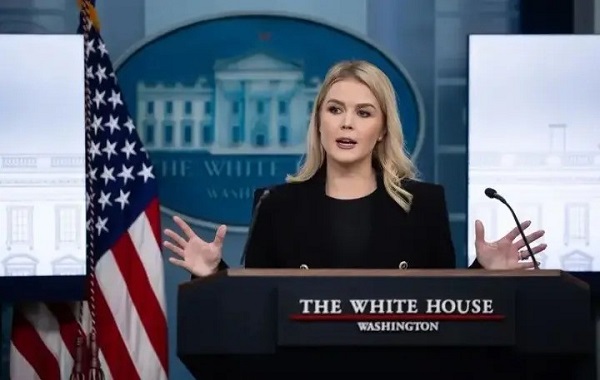
HuffPost journalists reached out to the White House for clarification, asking who proposed Budapest as the venue for the talks. The response they received shocked many observers. White House Press Secretary Karoline Leavitt reportedly replied, “Your mom did,” while Communications Director Steven Cheung echoed the phrase moments later, repeating simply, “Your mom.”
The remarks, widely perceived as flippant and disrespectful, have drawn backlash from journalists and political commentators who view the exchange as undermining the seriousness of both the question and the broader diplomatic context.
The choice of Budapest carries historical weight. It was there, in 1994, that Ukraine signed the Budapest Memorandum a landmark agreement in which Kyiv surrendered its nuclear arsenal in exchange for security assurances from Russia, the United States, and the United Kingdom. These guarantees were meant to uphold Ukraine’s sovereignty and territorial integrity. However, many experts now view the memorandum as nullified by Russia’s subsequent actions, including the annexation of Crimea in 2014, the war in Donbas, and the full-scale invasion launched in 2022.
Given this context, the selection of Budapest as the venue for U.S.-Russia discussions has struck a nerve, especially among Ukrainian officials and supporters, who see it as potentially undermining the gravity of Ukraine’s ongoing struggle for sovereignty.
So far, the White House has not issued a formal apology or clarification regarding the exchange, further fueling criticism about the tone and professionalism of its communications team.
As the international community watches closely for developments related to the proposed Trump-Putin meeting, the incident has raised broader concerns about diplomatic sensitivity and the current administration’s handling of press relations in politically charged matters.
