

Ahmed Kamel – Egypt Daily News
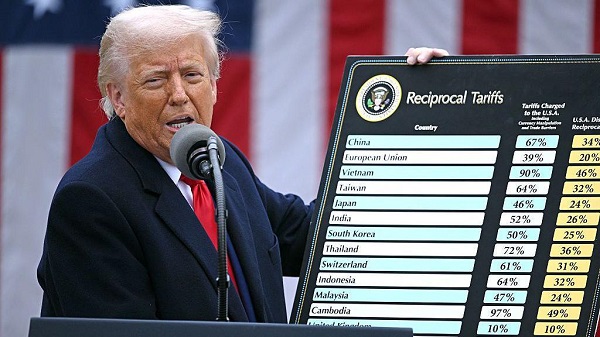
In a landmark decision with potentially far-reaching consequences for U.S. trade policy, a federal appeals court has ruled that former President Donald Trump’s sweeping global tariffs are unlawful. The 7-4 ruling from the U.S. Court of Appeals for the Federal Circuit asserts that Trump exceeded his presidential authority in imposing unilateral tariffs, dealing a legal blow to one of the most aggressive pillars of his America First economic agenda.
Despite the ruling, the tariffs which have significantly affected trade relations with countries such as China, Canada, and Mexico remain in effect, at least temporarily. The court has stayed enforcement of its decision until October 14, allowing time for the Trump legal team to appeal to the U.S. Supreme Court.
The Legal Basis of the Decision
At the heart of the ruling is the interpretation of the International Emergency Economic Powers Act (IEEPA) a Cold War-era law meant to give the president authority to deal with “unusual and extraordinary” threats to national security. Trump had invoked the IEEPA to justify the imposition of tariffs, arguing that the current global trade imbalance and illicit fentanyl trafficking from countries like China posed such a threat.
However, the majority of the appeals court disagreed, finding that the law does not authorize the imposition of tariffs, particularly on the scale enacted during Trump’s presidency.
“We discern no clear congressional authorization by IEEPA for tariffs of the magnitude of the Reciprocal Tariffs and Trafficking Tariffs,” the court wrote. “Tariffs are a core Congressional power.”
Seven of the eleven judges concluded that Trump’s actions violated the separation of powers, emphasizing that only Congress has the constitutional authority to impose tariffs. A subset of those judges went further, stating that IEEPA does not authorize any form of presidential tariffs, full stop.
Minority Opinion
In contrast, four judges dissented, siding with Trump’s legal team. They argued that the IEEPA’s broad language does allow tariffs under a declared national emergency, framing the trade practices of nations like China as an “unusual and extraordinary threat.”
They maintained that the law’s language — which gives the president power to “regulate” imports — could be interpreted to include tariffs.
“IEEPA’s language, as confirmed by its history, authorizes tariffs to regulate importation,” the minority judges wrote.
Trump’s Response
Trump responded swiftly and defiantly via his social media platform, denouncing the decision and warning that any judicial interference with his tariff policy would “literally destroy the United States of America.”
“With the help of the United States Supreme Court, we will use [tariffs] to the benefit of our Nation, and Make America Rich, Strong, and Powerful Again!” Trump declared.
He framed the legal battle as not just about tariffs, but as a broader test of presidential authority in matters of national and economic security.
A Supreme Court Showdown Looms
The ruling has now teed up what could become one of the most consequential legal battles about executive power and trade policy in decades. If the Supreme Court agrees to hear the case, it would be asked to rule on whether a president can unilaterally reshape trade relations through emergency powers an issue with vast implications not only for Trump but for future administrations of either party.
Legal scholars have noted that Congress never explicitly included tariffs in the IEEPA, and no other president had attempted to use it as a tool for imposing trade duties prior to Trump.
“This case is not just about trade; it’s about the limits of executive power,” one legal analyst observed.
Background and Implications
The case was brought by a coalition of small U.S. businesses and states that argued the tariffs had harmed their operations and exceeded presidential authority. A lower court the Court of International Trade in New York initially ruled the tariffs illegal earlier this year. That decision was promptly appealed by the Trump administration.
The stakes are high. If the Supreme Court upholds the lower court ruling, it could strip future presidents of a powerful and flexible tool for unilateral trade action, forcing such moves to go through Congress a process that is typically slower and more politically fraught.
The Trump administration has not fully rolled back Trump’s tariffs and may also be watching the legal battle closely, as a ruling against Trump could bind future presidents as well.
What Happens Next
- October 14: The date when the current stay on enforcement expires.
- Appeal to the Supreme Court: Expected from Trump’s legal team in the coming weeks.
- Potential nationwide implications: A ruling from the Supreme Court could reset the boundaries of presidential authority in economic emergencies.
Until then, Trump’s tariffs remain in place but the legal foundation beneath them is increasingly shaky.
